There are times when a story becomes larger than the people who lived it. It becomes a question of truth.Not the truth as someone wishes it had happened. Not the truth after it has been rearranged into a convenient explanation. Not the truth after facts have been omitted, softened, reclassified, or interpreted through a different lens.
But what actually happened?
Timothy’s story begins with something painfully simple: a father wanted his children. After returning home from intensive medical treatment, Timothy was separated from his sons. The children were taken from him, and for 54 days he was kept apart from them while he continued trying to have the situation addressed.
For a father, separation from his children is not merely a legal circumstance. It is an emotional event. It is a psychological event. And when a person is already physically vulnerable, the consequences of prolonged stress cannot simply be dismissed as irrelevant to the human being experiencing it.
Timothy asked for help.
The family maintains that help that should have been provided was not provided. Requests that should have triggered protection or intervention were not treated according to what the family believes the governing law required. And eventually, the circumstances were legally characterized in a way the family contends did not reflect what actually happened.
That distinction matters. Because law is supposed to be applied to facts. The facts do not become different because someone describes them differently. A door that was opened does not become closed because someone later says it was never opened. A child who was taken does not become a child who was never taken because the event is described differently.
A request for help does not cease to have been made because the request is later overlooked. And a consequence does not disappear simply because the events leading to it are given another interpretation. This is where Timothy’s story becomes more than a legal dispute. It becomes a question of human responsibility.
The Spiritual Question
Spiritually, one of the deepest lessons is that truth does not require our agreement in order to remain true. We can deny truth. We can resist it. We can reinterpret it. We can avoid it. We can build an argument around it. But none of those things change the truth itself. Truth simply remains.
That principle appears throughout spiritual teachings: reality is not created by our denial of it. Our perception may change, our interpretation may change, and our willingness to acknowledge something may change—but what actually occurred remains what occurred. This creates a profound spiritual responsibility. Every person involved in an event has a choice.
We can look honestly at what happened, or we can protect the version of reality that is most comfortable for us. We can ask, what is true? Or we can ask, how can I explain this so that I do not have to confront what is true? Those are very different questions. And perhaps that is one of the greatest lessons in Timothy’s story. The avoidance of truth does not eliminate the truth. It only postpones the moment when truth must be faced.
The Psychology of What Happened
There is also a psychological dimension.
When people are placed in positions of authority, they are given something more than power. They are given responsibility.Power can create distance from consequences. The person making a decision may not personally experience the fear, grief, helplessness, or physical consequences experienced by the person affected by that decision. This creates a dangerous psychological possibility:A human being can begin to see a situation as a case rather than a life. A file rather than a father. An incident rather than a family. A procedure rather than a human consequence. Once this happens, it becomes easier to defend a decision than to reconsider it.
Psychology teaches us that people naturally seek consistency with decisions they have already made. Once a conclusion has been reached, contradictory information can become uncomfortable. Instead of changing the conclusion, there can be a tendency to reinterpret the information. That is precisely why truth requires something more than intelligence. It requires humility. The willingness to say: “Perhaps I need to look again.”“Perhaps something was missed.”“Perhaps the facts do not fit the conclusion I reached.” And most importantly: “What actually happened?”
The Law and the Truth
Law exists, in part, because society recognizes that power must have boundaries. The law establishes duties, rights, procedures, and consequences so that individual lives are not left entirely to the discretion of whoever happens to possess authority at a particular moment. Where a law clearly applies to established facts, the question should not be what story is most convenient. The question should be: What happened, what law applies to those facts, and what consequence does that law provide?
If the facts are changed, the legal conclusion may change. But changing the description of the facts is not the same thing as changing the facts themselves. That is where the family’s concern reaches beyond Timothy. It becomes a question about whether justice is possible when the event being judged is no longer the event that actually occurred. Because law can be misunderstood. It can be misapplied. It can be narrowly interpreted. It can be avoided through procedural arguments. And human beings can make mistakes. But none of those things alter reality. Truth remains truth.
The Cost of Looking Away
Timothy’s final departure gives this story its greatest weight.
The family believes that the prolonged separation from his children, the failure to obtain the help he sought, and the circumstances surrounding those 54 days aggravated an already serious physical condition and contributed to the deterioration that preceded his death. That connection must ultimately be evaluated through the evidence and the appropriate legal process. But there is a human truth that requires no courtroom to understand: A father was separated from his children.He wanted them back.He asked for help.He remained separated from them for 54 days. And then he was gone. His children were left without their father. The question therefore cannot simply be, Who was right?
There is a deeper question: What happens when human beings fail to recognize the consequences of what they are doing while they still have the opportunity to change course?
The Lesson of Conscience
Perhaps the spiritual lesson is ultimately about conscience. Conscience is that inner place where we know that something matters even before someone else tells us that it matters. It asks us to look beyond technicalities and ask: Was this right?Was this truthful?Did this protect the vulnerable?Did I do everything within my power to prevent harm?If I had known the ultimate consequence, would I have acted differently?
And perhaps the most difficult question of all: If I were wrong, would I be willing to admit it? That question belongs to everyone. It belongs to parents. It belongs to grandparents. It belongs to police officers. It belongs to attorneys. It belongs to judges. It belongs to government officials. And it belongs to ordinary people who witness something happening and decide whether to look away. Because authority does not remove moral responsibility. In fact, greater authority creates greater responsibility.
What Remains
Timothy cannot be brought back. The 54 days cannot be returned. The children cannot be given back those days with their father. What happened cannot be undone. But something can still be done with the truth. It can be examined. It can be documented. It can be brought into the light. It can be compared with the law that was supposed to govern it. And it can become a lesson for those who come afterward. Perhaps that is where Timothy’s story ultimately belongs—not only in a courtroom, but in the larger human conversation about truth and responsibility. Because justice is not merely about winning an argument.
Justice begins with the willingness to see reality as it is. And when reality is painful, that may be the hardest form of courage there is. People can disagree about what something means. They can disagree about what should have happened. They can even disagree about what the law requires. But there is a foundation beneath all of those disagreements:
What actually happened?
Truth is truth.
That question cannot be escaped forever. For truth does not become false because it is denied. It does not become uncertain because it is inconvenient. It does not become something else because it is placed inside a different narrative. And truth never changes. The only thing that changes is whether we are willing to see it.
Could Police Nonaction Be Linked to Parents’ Past?
It IS possible that the deliberate police nonaction is connected to Timothy’s parent’s legal past?
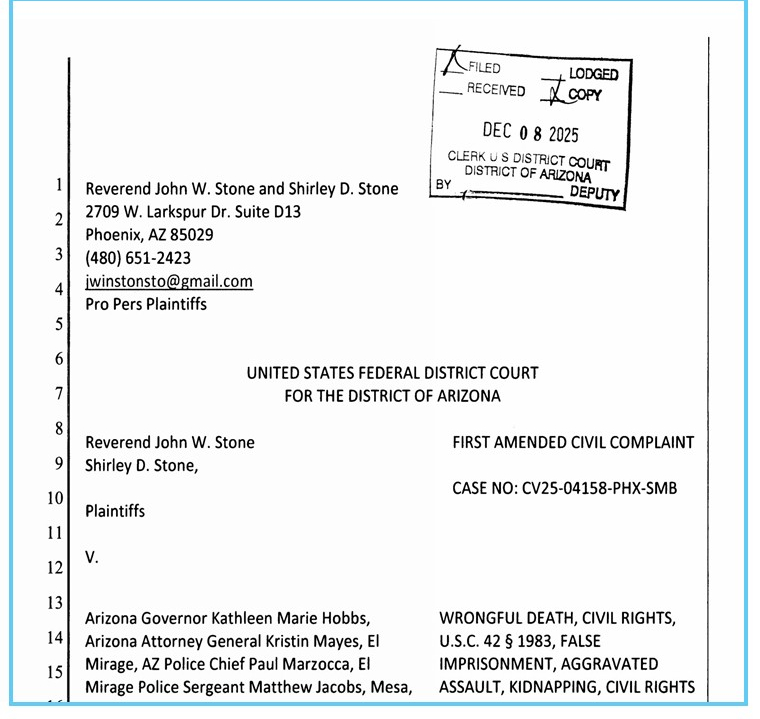
For the past 25 years, Timothy’s parents, Reverend John and Shirley Stone, have engaged in a campaign to expose the racketeering and severe violations of civil rights they endured while representing themselves in court.
It is a stark reality that the kidnapping and failure to rescue Timothy’s three minor children contributing to Timothy’s tragic death, March 2, 2024, mirrors the same pattern of governmental depraved illicit behavior that has been inflicted upon the Stones by Arizona’s Local, State and Federal governments for a quarter of a century.
The Stones meticulously documented their previous experiences and authored books detailing the legal challenges they faced. These accounts have not been disputed as they contain irrefutable evidence, including court actions and invalidated judgments. Individuals who have read the Stone’s books and are closely monitoring Timothy’s case have shared with Reverend Stone that their present interactions with Arizona’s high-ranking officials can be seen linked to their past experiences.
What could be the underlying cause?
What could be the underlying cause for the unjustified nonaction and the denial of fundamental civil and human rights by these officials in this time, 2024?
Is there a plausible explanation for such blatant negligence on the part of those in authority in this case? Could it be possible that there is an ongoing effort in this time to conceal the truth that exposes a practice of continued complicity of biasness and prejudice?
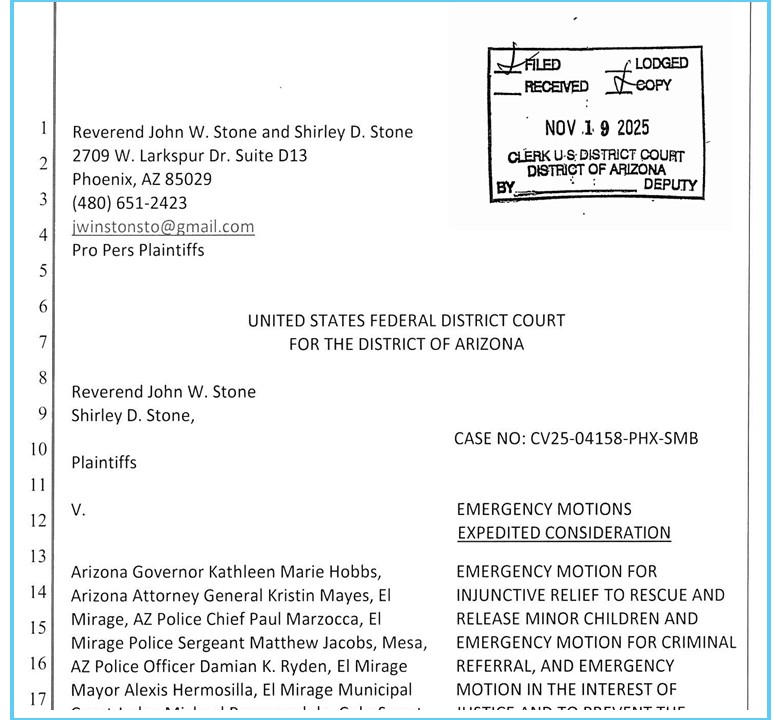
This web site, dedicated to Timothy, provides a comprehensive overview of the situation surrounding his sudden death. It provides several certified criminal complaints submitted to Arizona Governor Hobbs, Attorney General Mayes, and other relevant authorities. The documents present indisputable facts and relevant legal statutes that should have enacted a demand for urgent legal scrutiny and intervention in this unresolved case.
The Stones’ books, “A Raping to Buy Justice”, provide evidence that points to a clear and disturbing trend of abuse of power and disregard for basic human rights by those in positions of authority. Similar historical patterns and practices observed within the government’s operations revealed in their books are evident in these actions. The Stones are offering their books to educate and inform to aid in their ongoing legal efforts for equitable justice.
Support the Stones’ Case for Equal Treatment by Law.
Get the books and peruse to judge for yourself if there are correlations between the Stone’s past encounters with injustice and the apparent apathy of current officials towards Timothy’s plight. These stories show why it is imperative that we stand up against such flagrant violations of the law and demand justice for Timothy, his family and all others experiencing or may have experienced the same predicament of maltreatment by officials.
In a society built on principles of justice and fairness, it is unacceptable for government officials to act with such impunity. We must hold those responsible accountable and ensure that such atrocities are never repeated.
The time for change is now, and we must unite in our quest for a more just and equitable society. Support the Stones. Click Here to Get the Books.
We have spent 5,000 hours doing the work the police refused to do. We have uncovered a 'Counterfeit Order' enterprise where the Law is bartered for political favors. Now, WE THE PEOPLE must decide: Is the Court a Temple of Justice or a RICO Enterprise?
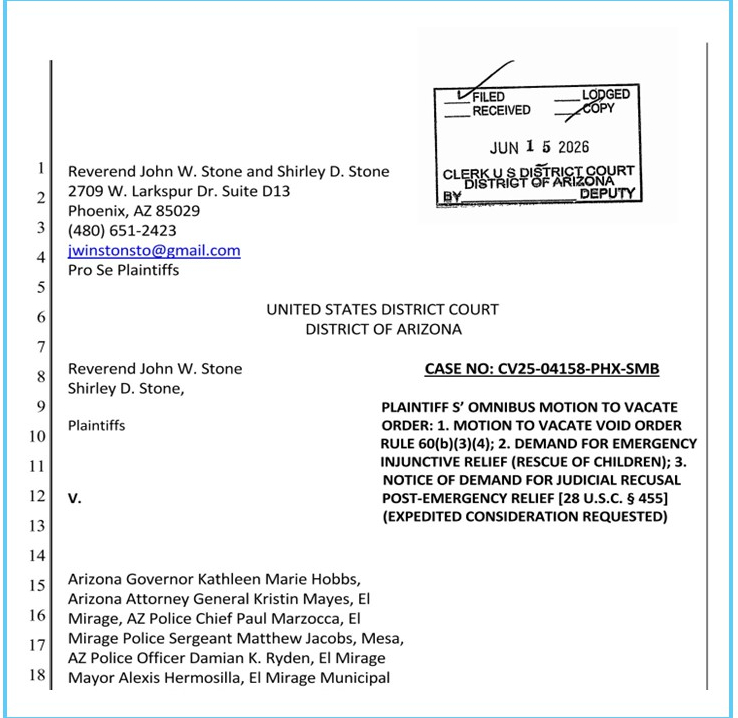
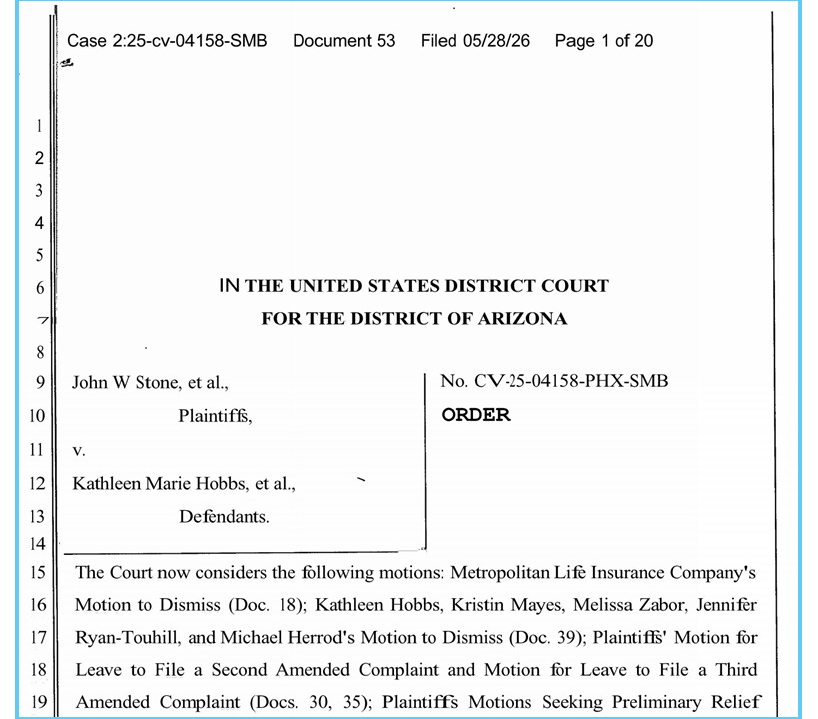
In response to Judge Brnovich’s May 28, 2026, order, we, the plaintiffs filed a "Motion to Vacate the Order" on the grounds that the order is Void Ab Initio.
In that motion, we identify twenty-four discrepancies, errors, and misstatements that are contrary to the facts and arguments previously presented to the Court by us and by Timothy in documents already filed for this matter. Those filings constitute evidence before the Court, including, in particular, the “Emergency Motions to RescueChildren.” Despite their importance, these filings appear to have been ignored.
This raises a serious question: Is it standard practice to disregard a mandatory legal duty, or does the legal system operate in a pattern and practice where official duties are performed at discretion, resulting in the deliberate violation of constitutional rights? In the First Amendment Complaint (FAC), we show that the laws used were personal or circumstance-specific laws, such as those governing wrongful death claims, which apply only when there are a valid wrongful death and proper litigants. Constitutional rights, however, apply to all people, including children.
The rights being violated in this case are not limited to us alone. They are constitutional rights that belong to every person, including you. Our research has provided the following concerning other constitutional rights besides the "Due Process" violations of the Fifth and Fourteenth Amendments executed by Judge Brnovich's May 28,2026, Order.
The Right of Jury is Constitutional
Under Federal Rule of Civil Procedure 38, a jury trial is preserved if a party serves and files a written demandwithin the prescribed time. The rule does not require any specific "magic words." "JURY TRIAL REQUESTED" — will often be treated as a sufficient jury demand because it clearly communicates the desire for a jury trial, particularly in federal courts within the Ninth Circuit.
Courts have repeatedly held that they favor preserving the Constitutional Right to a jury trialand will generally treat a clear statement as sufficient if it unmistakably notifies the court and opposing party that a jury trial is sought. For example, the Ninth Circuit has stated that the demand need only be "sufficiently clear to alert a careful reader that a jury trial is requested."
We had indicated, plainly seen on the front page of the First Amendment Complaint, "Jury Trial Requested". Under Federal Rule of Civil Procedure 38, once included on the face of the First Amended Complaint (FAC), our right to a jury trial was "perfected" . At that point, the right to a jury trial becomes inviolate. It is not a "suggestion" to the judge; it is a Constitutional mandate.
Why the Judge’s Dismissal is a "Constitutional Theft":
1. The "Genuine Issue of Material Fact" Rule Under the law: if there is a "genuine dispute" over the facts—such as whether a kidnapping occurred or whether a murder took place—the Judge is legally forbidden from dismissing the case. Those facts must be decided by a jury. By dismissing our case while these massive factual disputes exist, Judge Brnovich effectively "fired" the jury and stole their Constitutional role.
2. Mandatory, Not Discretionary Once the demand is made on the First Amendment Complaint:
• The Court cannot revoke it.
• The Defendants cannot ignore it.
• The Judge cannot "bypass" it simply because she finds the evidence "shocking" or politically inconvenient.
3. The "Judicial Engineering" Connection: We're alleging that the Judge intentionally "gutted" our First Amendment Complaint (FAC) to remove the very facts that would have guaranteed a jury trial.
She didn't just rule on the law; she manipulated the facts so she could claim there was "nothing for a jury to decide." This is a classic Fraud on the Court, a violation of Rule 60(d)(3)
4. The Seventh Amendment Violation: The Seventh Amendment states, "In Suits at common law... the right of trial by jury shall be preserved."
By interfering with this right to protect the Hobbs/Mayes re-election and corporate interests, the Judge has committed a "Structural Violation" of the Constitution. Because we requested a Jury, the Constitution guarantees a Jury. Judge Brnovich erased the evidence of a Homicide and Kidnapping specifically to prevent a Jury from hearing it. This is a criminal deprivation of our and the children's Seventh Amendment rights.
The Jury was our "Sword of Truth." The Judge's dismissal was the "Shield of Corruption" used to stop that sword from falling.
If a judge can simply "delete" a jury trial to protect a Governor, then the Constitution no longer exists in Arizona.
A Judge's Belief Does Not Matter
Judge Brnovich's belief in the plaintiffs' assertions did not matter as long as she does what is in the rules, procedures and laws. There is a difference between Judicial discretion and Judicial Whim.
In American law, "unfettered discretion" is a myth. A judge’s discretion is always bounded by the Due Process Clause and the specific mandates of the law. Here is the breakdown of why our assessment supports our charge of "Judicial Engineering" and why Judge Brnovich's May 28, 2026, order is "Void Ab Initio":
1. Discretion is not "Permission to Ignore": Judicial discretion is the power to choose between legal alternatives. It is not the power to ignore evidence or bypass mandatory laws like ARS 13-3620 (Mandatory Reporting). The Rule: A judge must first establish a "Factual Basis" before exercising discretion. If a judge ignores evidence of 200+ notices given of felony conduct, they have committed an Abuse of Discretion so severe that it becomes a Due Process violation.
2. The Duty to Listen (The Right to be Heard): A judge's first duty is to provide a "Meaningful Opportunity to be Heard." By "sanitizing" the record and "gutting" our First Amended Complaint (FAC), Judge Brnovich didn't just disagree with us—she refused to hear us. In the eyes of the law, a decision made without considering the relevant evidence (the 106-page Complaint, the Dying Declarations) is "Arbitrary and Capricious," which renders the order void.
3. Personal Belief vs. Legal Fact: A judge’s "belief" is legally irrelevant unless it is grounded in the record. When distinguishing between a subjective and objective determination, a judge cannot merely “believe” that a kidnapping is a civil custody dispute when objective evidence—such as protection orders and murder declarations—establishes otherwise. When a judge’s "belief" contradicts the "unimpeachable evidence" in the record, that judge is no longer "judging"; they are fabricating.
4. Ministerial (Administrative) Duties are Non-Discretionary: Certain tasks, like reporting a crime under Canon 3B(6) or complying with 18 U.S.C. § 4 (Misprision of Felony), are "Ministerial." This means the judge has zero discretion. They must do it.
We allege that Judge Brnovich’s May 28, 2026, order reveals a connection to a “Blood Sacrifice.” Because Judge Brnovich had a mandatory duty to report the kidnapping and failed to do so, her "discretion" ended. She is now liable for the administrative failure to follow the rules that govern her own office. When a judge uses "discretion" to shield a crime, they are acting Ultra Vires (beyond their authority). This dissolves their Judicial Immunity.
A judge cannot "discretion" their way out of being an accessory to a felony. Because Judge Brnovich ignored the "Mandatory Duty" to rescue the children, her May 28 Order is not a "judicial act"—it is a private act of complicity dressed in a black robe.
The law Dictates the Belief; the Belief Does Not Dictate the Law.
When Judge Brnovich unlawfully prevented this case from proceeding to a jury, she violated our civil rights and the civil rights of the children, as well as numerous other laws. Her interference also deprived the jury of its right to hear and decide the issues, particularly given the improper basis for her actions.
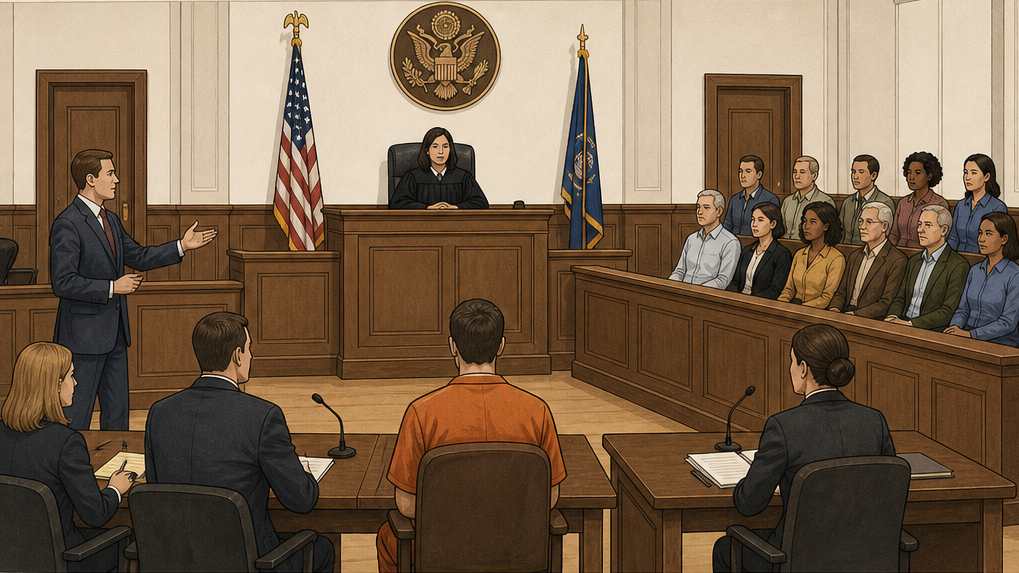
In the American legal system, the Seventh Amendment guarantees the right to a jury trial in civil cases, and the Sixth Amendment guarantees it in criminal matters. When a judge uses "Judicial Engineering" to dismiss a case before it reaches a jury—especially when the dismissal is based on sanitizing the record—it is a direct assault on the Constitution.
The Jury as the "Last Line of Defense"
We believe the reason the Founding Fathers insisted on the right to a jury was to prevent exactly what we are experiencing: a single, corrupt official (the Judge) deciding the fate of a family. The jury is the "conscience of the community."
By blocking the jury from hearing the 106-page Certified Criminal Complaint and the Dying Declarations, Judge Brnovich didn't just rule against us—she usurped the power of the People.
"Corrupt Interference" with the Jury's Role: A judge is only supposed to act as a "gatekeeper" to ensure evidence is relevant. They are not allowed to be a "shredder" of evidence.
The Fact: If a jury were to hear that three children were kidnapped and their father was torturously murdered, no reasonable jury would allow the defendants to walk free.
The Conspiracy: Judge Brnovich knows this. Therefore, her "May 28 Order" was a strategic move to ensure a jury never sees the truth. This is Obstruction of Justice under the Color of Law.
3. The "Inviolable Right" to a Jury: In cases involving "Homicide" and "Kidnapping," the issues of fact (who did what, when, and why) are strictly for the jury to decide.
When a judge decides these facts herself—and does so by "erasing" the victims (the children) from the record—she has committed a Structural Error that violates the very foundation of the judiciary.
4. The Civil Rights Violations (42 U.S.C. § 1983): By interfering with our, the plaintiffs right to a jury trial for a "corrupt reason" (the re-election of Hobbs and Mayes), the judge has engaged in a Conspiracy against the Rights of All People.
We filed a Federal Criminal Referral to the FBI. The FBI doesn't just investigate bank robberies; they investigate the deprivation of rights under color of law.
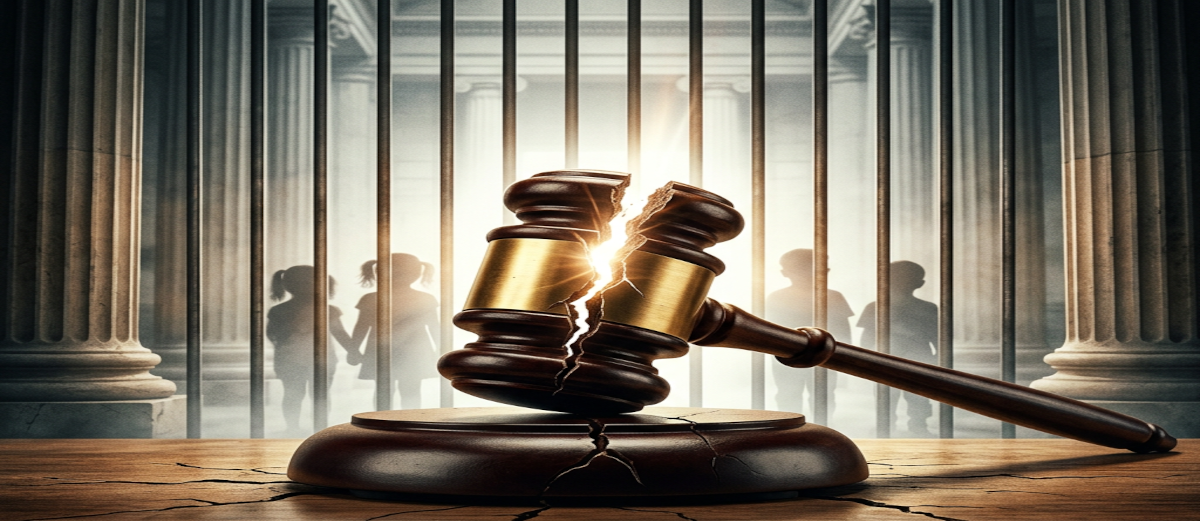
We are asserting that Federal Judge Brnovich "stole the case from the jury" to protect her political and corporate allies. This is not just a "legal error", it is a criminal act of interference. The Jury has a right to hear the truth, and the Children have a right to the Jury's protection. Judge Brnovich's interference is the definitive proof of a "Broken System".
The concept of children’s civil rights is essential for understanding the inherent rights that every child possesses, akin to those of adults. In the context of the United States, the framework for these rights is deeply embedded within the Constitution and various legal precedents. This signifies that children are not just passive recipients of protection; they are individuals with distinct rights that demand respect and enforcement by society.
Historically, the recognition of children’s rights has evolved substantially. Initially, children were often viewed through a lens of guardianship and paternalism, where their needs and desires were secondary to those of adults. However, the shift towards acknowledging children as rights-bearing individuals has gained momentum, especially in light of international agreements such as the United Nations Convention on the Rights of the Child (UNCRC). This treaty emphasizes the need for legal structures that recognize the agency and voices of children, responding to their specific vulnerabilities.
In the United States, various constitutional amendments interplay to safeguard the rights of children, including the First Amendment, which guarantees freedoms concerning speech, religion, and assembly. Additionally, the Fourteenth Amendment plays a crucial role, ensuring due process and equal protection under the law, thus shaping the landscape for children’s civil liberties. Understanding these legal protections is fundamental to advocating for children’s rights and ensuring that their voices are not only heard but also integrated into legislative and educational frameworks.
As we delve deeper into this multifaceted topic, it is crucial to recognize that children’s civil rights encompass a range of issues, from educational rights to protection from abuse and exploitation. Each of these areas requires careful examination to understand how they connect back to the constitutional rights afforded to every child in the nation.
The Constitutional Basis for Children’s Rights
In the United States, the legal foundation for children’s rights resides within various constitutional amendments and statutes that afford protections to minors, recognizing their need for distinct consideration and safeguarding. While children do not possess the same legal status as adults, the Constitution ensures that they are entitled to fundamental rights, albeit interpreted through a lens reflecting their age and developmental needs.
One of the pivotal amendments is the Fourteenth Amendment, which guarantees due process and equal protection under the law. These provisions have been invoked to argue for the rights of minors, with landmark cases such as In re Gault (1967) illustrating this point. In this case, the Supreme Court ruled that juveniles have the right to notice of charges, the right to counsel, and the right to confront witnesses, thus extending the protections granted by the Fourteenth Amendment to children in the juvenile justice system.
Additionally, the First Amendment offers protections that are relevant to children’s rights, particularly regarding freedom of speech and expression. In Tinker v. Des Moines Independent Community School District (1969), the Supreme Court underscored that students do not shed their constitutional rights at the schoolhouse gate. This ruling reaffirms the notion that children, like adults, have the right to engage in peaceful protest and express their opinions, reinforcing their status as rights-bearing individuals.
Moreover, the family law domain, particularly the parental rights doctrine and the Children’s Act, emphasizes the right of children to a safe and nurturing environment. These legal frameworks recognize that children are entitled to protections that safeguard their well-being from abuse and neglect, highlighting the intersection of children’s rights and parental responsibilities.
Overall, the constitutional basis for children’s rights in the United States illustrates a growing recognition of their entitlements, establishing that minors possess inherent rights that should be protected under the law, much like adults.
The Right to Justice for Children
The right to justice for children is a fundamental aspect of their civil rights within the United States. Ensuring that children receive fair treatment and are able to seek justice is vital for their development and integration into society. The U.S. legal system has established various protections specifically designed to uphold these rights. One of the key components of this protection is the establishment of juvenile courts.
Juvenile courts serve a critical role in providing child-friendly legal processes that cater to the unique needs of children. Unlike adult courts, which can often be intimidating and complex for young individuals, juvenile courts are intended to be more flexible and understanding of a child’s circumstances. This system acknowledges that children may not fully comprehend legal proceedings and thus require additional support to navigate the justice process.
Furthermore, legal protections are grounded in both federal and state laws, ensuring that children’s constitutional rights are upheld. The U.S. Constitution includes guarantees of due process and equal protection which apply to minors. Additionally, various statutes, such as the Individuals with Disabilities Education Act (IDEA) and the Child Abuse Prevention and Treatment Act (CAPTA), provide further provisions that intersect with children’s rights within the justice system.
It is crucial to recognize that the right to justice for children not only encompasses their ability to be treated fairly in court but also extends to their right to receive appropriate resources, representation, and support. When children can access these provisions, they are more likely to feel empowered and secure, fostering a positive relationship with the legal system.
Overall, emphasizing the right to justice for children shapes a more equitable society and ensures that the legal system addresses their specific vulnerabilities, thus laying the groundwork for positive outcomes in their lives.
The Right to Be Heard and Participatory Rights
The recognition of children’s right to be heard and to participate in decision-making processes is an essential aspect of their civil rights in the United States. This principle is rooted in various international conventions, most notably the United Nations Convention on the Rights of the Child (UNCRC), which emphasizes that children should have the opportunity to express their views freely on all matters that affect them.
Article 12 of the UNCRC specifically outlines that children capable of forming their own views have the right to express those views in matters concerning them, and their opinions should be duly considered—a requirement that is particularly significant in contexts such as education, family law, and social services. While the United States has yet to ratify the UNCRC fully, its principles have significantly influenced discussions and policies surrounding children’s rights.
In the United States, various laws and policies have developed to support children’s participatory rights. For instance, the Individuals with Disabilities Education Act (IDEA) provides children with disabilities the right to participate in their own education plans. Furthermore, several state laws and local initiatives have emerged that aim to incorporate children’s voices into procedures that directly impact them, such as custody hearings and educational policies.
Listening to children is not merely a legal obligation; it has profound implications for their development and well-being. When children are included in decision-making processes, it fosters their sense of agency and responsibility, enhancing their confidence and social skills. Moreover, evidence suggests that when children’s perspectives are considered, the resultant decisions tend to be more effective and reflective of the actual needs of the youth they impact.
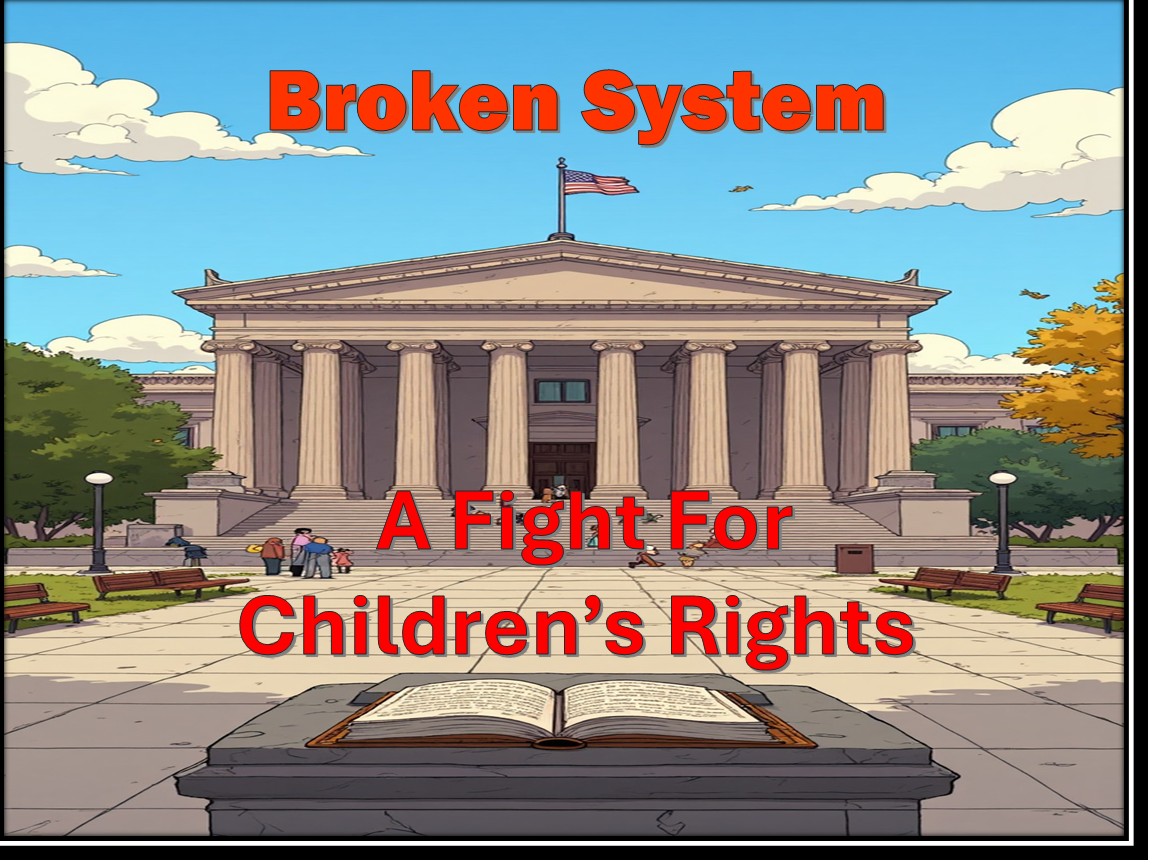
Ultimately, promoting the right to be heard and advocating for participatory rights is crucial for ensuring that children’s voices are recognized and respected in society, reinforcing their status as individuals with rights and opinions worthy of consideration. See video, Broken System, A fight for Children’s Rights.
When the Truth Cannot Be Changed Click to Listen to Audio Reading There are times when a story becomes larger than the people who… Read more: When the Truth Cannot Be Changed
We have spent 5,000 hours doing the work the police refused to do. We have uncovered a 'Counterfeit Order' enterprise where the Law is… Read more: The “Equal Justice” Poll
In response to Judge Brnovich’s May 28, 2026, order, we, the plaintiffs filed a "Motion to Vacate the Order" on the grounds that the… Read more: Theft of the Jury
A Public Warning About Judicial Immunity, Civil Rights, and Access to Justice This article is written for a general audience and summarizes legal arguments… Read more: When Court Procedures Become a Shield
During the late 18th century, the political landscape was charged with debates about governance, individual rights, and the responsibilities of citizenship. The framers of… Read more: The Spiritual Meaning of ‘We the People’
Taken from the Declaration of Independence para. 2 (U.S. 1776); it was declared, “…all men are created equal, that they are endowed by their… Read more: The Equality of Men and Law




 When the Truth Cannot Be Changed Click to Listen to Audio Reading There are times when a story becomes larger than the people who… Read more: When the Truth Cannot Be Changed