When the Truth Cannot Be Changed
When the Truth Cannot Be Changed
Click to Listen to Audio Reading
There are times when a story becomes larger than the people who lived it. It becomes a question of truth.Not the truth as someone wishes it had happened. Not the truth after it has been rearranged into a convenient explanation. Not the truth after facts have been omitted, softened, reclassified, or interpreted through a different lens.
But what actually happened?
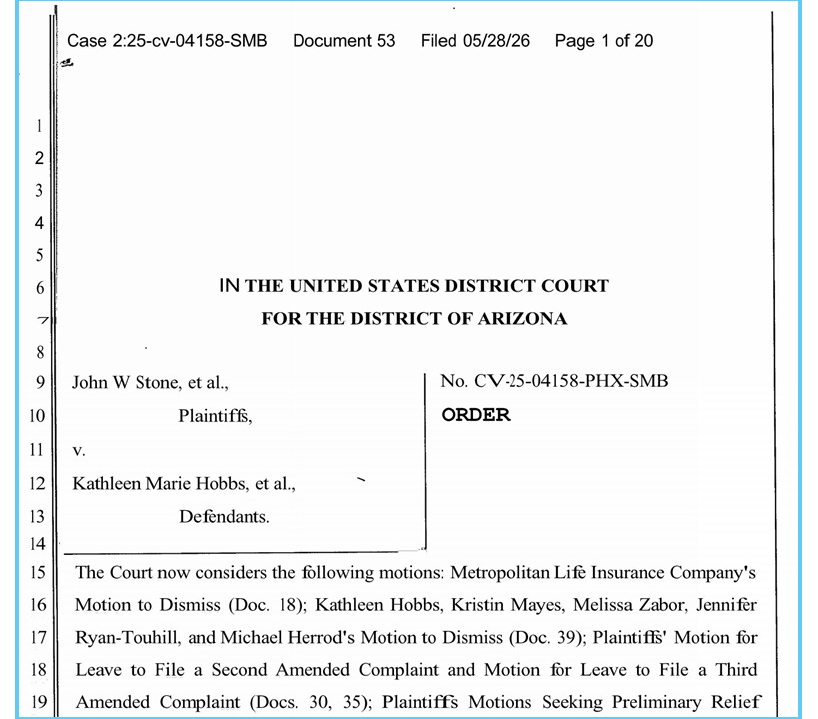
Timothy’s story begins with something painfully simple: a father wanted his children. After returning home from intensive medical treatment, Timothy was separated from his sons. The children were taken from him, and for 54 days he was kept apart from them while he continued trying to have the situation addressed.
For a father, separation from his children is not merely a legal circumstance. It is an emotional event. It is a psychological event. And when a person is already physically vulnerable, the consequences of prolonged stress cannot simply be dismissed as irrelevant to the human being experiencing it.
Timothy asked for help.
The family maintains that help that should have been provided was not provided. Requests that should have triggered protection or intervention were not treated according to what the family believes the governing law required. And eventually, the circumstances were legally characterized in a way the family contends did not reflect what actually happened.
That distinction matters. Because law is supposed to be applied to facts. The facts do not become different because someone describes them differently. A door that was opened does not become closed because someone later says it was never opened. A child who was taken does not become a child who was never taken because the event is described differently.
A request for help does not cease to have been made because the request is later overlooked. And a consequence does not disappear simply because the events leading to it are given another interpretation. This is where Timothy’s story becomes more than a legal dispute. It becomes a question of human responsibility.
The Spiritual Question
Spiritually, one of the deepest lessons is that truth does not require our agreement in order to remain true. We can deny truth. We can resist it. We can reinterpret it. We can avoid it. We can build an argument around it. But none of those things change the truth itself. Truth simply remains.
That principle appears throughout spiritual teachings: reality is not created by our denial of it. Our perception may change, our interpretation may change, and our willingness to acknowledge something may change—but what actually occurred remains what occurred. This creates a profound spiritual responsibility. Every person involved in an event has a choice.
We can look honestly at what happened, or we can protect the version of reality that is most comfortable for us. We can ask, what is true? Or we can ask, how can I explain this so that I do not have to confront what is true? Those are very different questions. And perhaps that is one of the greatest lessons in Timothy’s story. The avoidance of truth does not eliminate the truth. It only postpones the moment when truth must be faced.
The Psychology of What Happened
There is also a psychological dimension.
When people are placed in positions of authority, they are given something more than power. They are given responsibility.Power can create distance from consequences. The person making a decision may not personally experience the fear, grief, helplessness, or physical consequences experienced by the person affected by that decision. This creates a dangerous psychological possibility:A human being can begin to see a situation as a case rather than a life. A file rather than a father. An incident rather than a family. A procedure rather than a human consequence. Once this happens, it becomes easier to defend a decision than to reconsider it.
Psychology teaches us that people naturally seek consistency with decisions they have already made. Once a conclusion has been reached, contradictory information can become uncomfortable. Instead of changing the conclusion, there can be a tendency to reinterpret the information. That is precisely why truth requires something more than intelligence. It requires humility. The willingness to say: “Perhaps I need to look again.” “Perhaps something was missed.” “Perhaps the facts do not fit the conclusion I reached.” And most importantly: “What actually happened?”
The Law and the Truth
Law exists, in part, because society recognizes that power must have boundaries. The law establishes duties, rights, procedures, and consequences so that individual lives are not left entirely to the discretion of whoever happens to possess authority at a particular moment. Where a law clearly applies to established facts, the question should not be what story is most convenient. The question should be: What happened, what law applies to those facts, and what consequence does that law provide?
If the facts are changed, the legal conclusion may change. But changing the description of the facts is not the same thing as changing the facts themselves. That is where the family’s concern reaches beyond Timothy. It becomes a question about whether justice is possible when the event being judged is no longer the event that actually occurred. Because law can be misunderstood. It can be misapplied. It can be narrowly interpreted. It can be avoided through procedural arguments. And human beings can make mistakes. But none of those things alter reality. Truth remains truth.
The Cost of Looking Away
Timothy’s final departure gives this story its greatest weight.
The family believes that the prolonged separation from his children, the failure to obtain the help he sought, and the circumstances surrounding those 54 days aggravated an already serious physical condition and contributed to the deterioration that preceded his death. That connection must ultimately be evaluated through the evidence and the appropriate legal process. But there is a human truth that requires no courtroom to understand: A father was separated from his children. He wanted them back. He asked for help. He remained separated from them for 54 days. And then he was gone. His children were left without their father. The question therefore cannot simply be, Who was right?
There is a deeper question: What happens when human beings fail to recognize the consequences of what they are doing while they still have the opportunity to change course?
The Lesson of Conscience
Perhaps the spiritual lesson is ultimately about conscience. Conscience is that inner place where we know that something matters even before someone else tells us that it matters. It asks us to look beyond technicalities and ask: Was this right? Was this truthful?Did this protect the vulnerable? Did I do everything within my power to prevent harm? If I had known the ultimate consequence, would I have acted differently?
And perhaps the most difficult question of all: If I were wrong, would I be willing to admit it? That question belongs to everyone. It belongs to parents. It belongs to grandparents. It belongs to police officers. It belongs to attorneys. It belongs to judges. It belongs to government officials. And it belongs to ordinary people who witness something happening and decide whether to look away. Because authority does not remove moral responsibility. In fact, greater authority creates greater responsibility.
What Remains
Timothy cannot be brought back. The 54 days cannot be returned. The children cannot be given back those days with their father. What happened cannot be undone. But something can still be done with the truth. It can be examined. It can be documented. It can be brought into the light. It can be compared with the law that was supposed to govern it. And it can become a lesson for those who come afterward. Perhaps that is where Timothy’s story ultimately belongs—not only in a courtroom, but in the larger human conversation about truth and responsibility. Because justice is not merely about winning an argument.
Justice begins with the willingness to see reality as it is. And when reality is painful, that may be the hardest form of courage there is. People can disagree about what something means. They can disagree about what should have happened. They can even disagree about what the law requires. But there is a foundation beneath all of those disagreements:
What actually happened?
Truth is truth.
That question cannot be escaped forever. For truth does not become false because it is denied. It does not become uncertain because it is inconvenient. It does not become something else because it is placed inside a different narrative. And truth never changes. The only thing that changes is whether we are willing to see it.
Latest Posts
- When the Truth Cannot Be Changed
 When the Truth Cannot Be Changed Click to Listen to Audio Reading There are times when a story becomes larger than the people who… Read more: When the Truth Cannot Be Changed
 - Could Police Nonaction Be Linked to Parents’ Past?It IS possible that the deliberate police nonaction is connected to Timothy’s parent’s legal past? For the past 25 years, Timothy’s parents, Reverend John… Read more: Could Police Nonaction Be Linked to Parents’ Past?
- The “Equal Justice” PollWe have spent 5,000 hours doing the work the police refused to do. We have uncovered a 'Counterfeit Order' enterprise where the Law is… Read more: The “Equal Justice” Poll
- Theft of the JuryIn response to Judge Brnovich’s May 28, 2026, order, we, the plaintiffs filed a "Motion to Vacate the Order" on the grounds that the… Read more: Theft of the Jury
- When Court Procedures Become a ShieldA Public Warning About Judicial Immunity, Civil Rights, and Access to Justice This article is written for a general audience and summarizes legal arguments… Read more: When Court Procedures Become a Shield
- Plaintiffs Filed Omnibus Reply to Defendants’ ResponsesIn CASE NO: CV25-04158-PHX-SMB: In the Arizona Federal District Court, Plaintiffs Filed Omnibus Reply to Defendants’ Responses to Vacate May 28, 2026, Order as… Read more: Plaintiffs Filed Omnibus Reply to Defendants’ Responses
- The Spiritual Meaning of ‘We the People’During the late 18th century, the political landscape was charged with debates about governance, individual rights, and the responsibilities of citizenship. The framers of… Read more: The Spiritual Meaning of ‘We the People’
- Understanding Children’s Civil Rights in the USIntroduction to Children’s Civil Rights The concept of children’s civil rights is essential for understanding the inherent rights that every child possesses, akin to… Read more: Understanding Children’s Civil Rights in the US
- Judge Ordered Kids to Stay with KidnappersAfter the Kidnapping and Death of Their Father, Federal Judge Susan M. Brnovich Followed the Defendant Officials in Keeping the Children with Their Captors,… Read more: Judge Ordered Kids to Stay with Kidnappers
- The Equality of Men and LawTaken from the Declaration of Independence para. 2 (U.S. 1776); it was declared, “…all men are created equal, that they are endowed by their… Read more: The Equality of Men and Law








VIDEO
Stone's Legal Fund