|
Getting your Trinity Audio player ready... |
A Public Warning About Judicial Immunity, Civil Rights, and Access to Justice
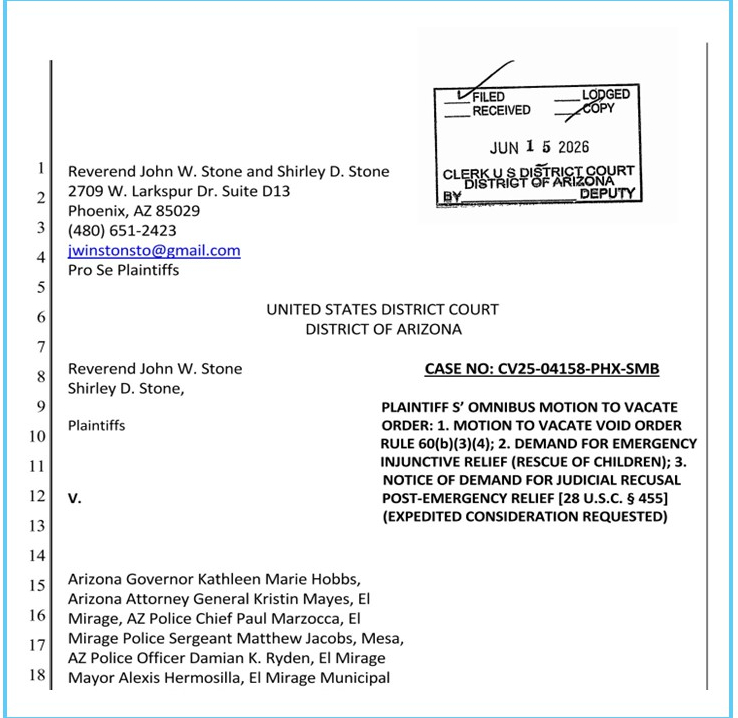
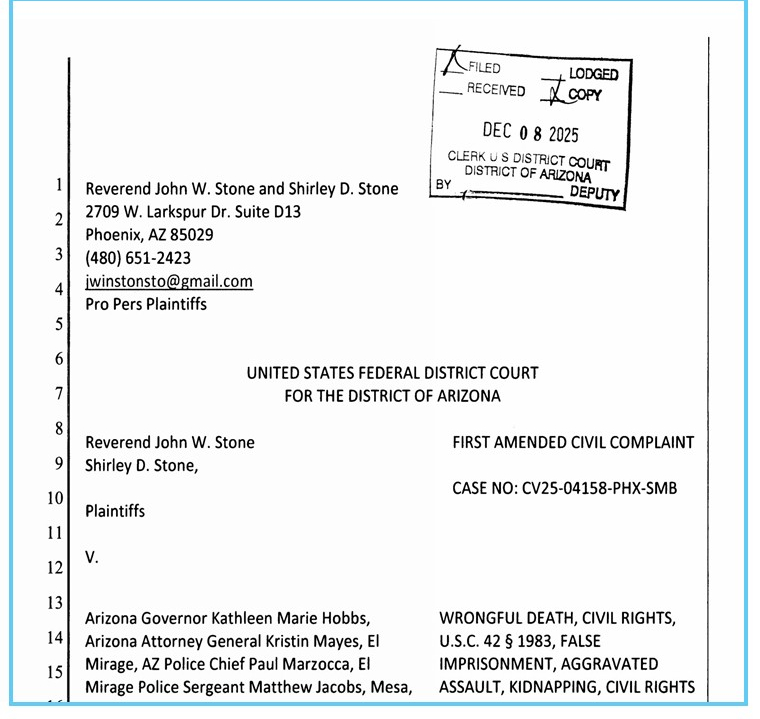
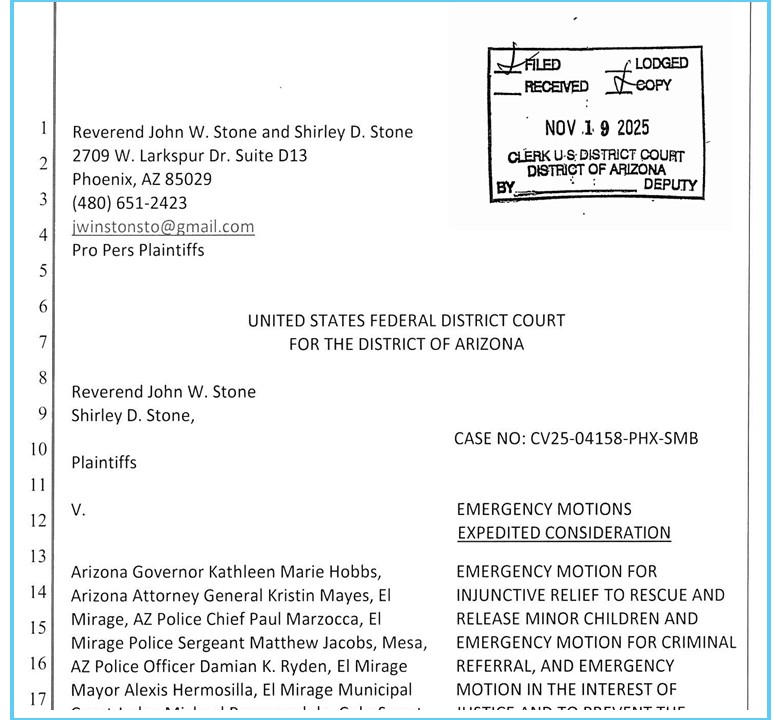
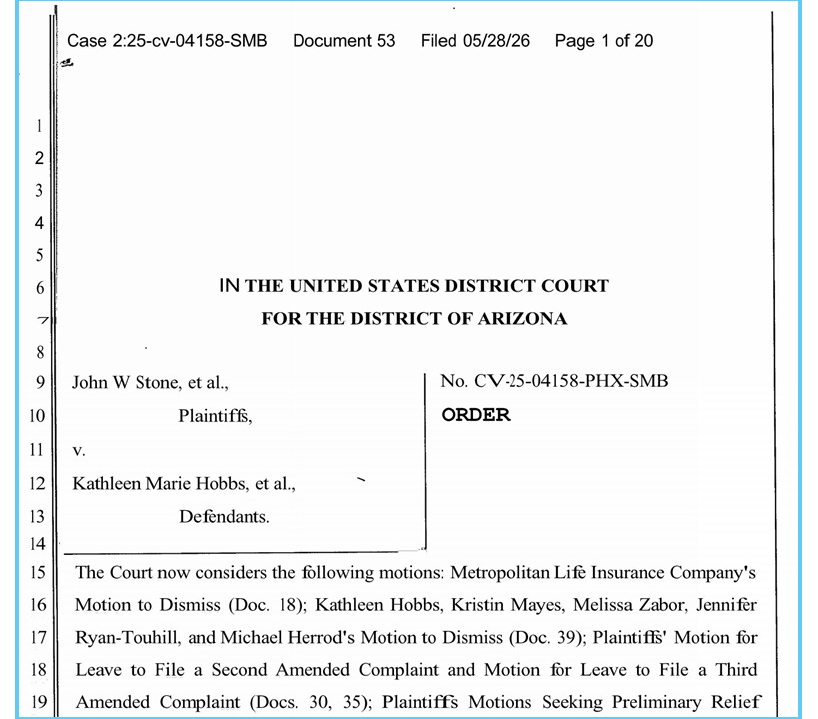
This article is written for a general audience and summarizes legal arguments and public concerns raised in a consolidated court filing in CASE NO: CV25-04158-PHX-SMB Stone vs. GovHobbs, et al. This is not legal advice. What is described here are presented as claims made in the filing.
Why This Matters
Most people believe courts exist to protect families, children, elders, people with disabilities, and anyone whose rights have been violated. But what happens when court procedures are used to block those protections instead of enforcing them?
This consolidated legal challenge raises a serious public warning: judicial immunity and procedural technicalities can be misused to protect officials from accountability, even when constitutional rights, child safety, disability rights, and family protections are at stake.
At the heart of the filing is a simple constitutional principle:
No public official — including a judge — is above the Constitution.
- Pro Se Civil Rights Pleadings Must Be Read Fairly
The Law
In Picking v. Pennsylvania Railway, 151 F.2d 240 (3d Cir. 1945), the court recognized that when a person files a civil rights case without a lawyer, courts should not dismiss or ignore the filing simply because it is imperfectly written.
Similarly, courts have long emphasized that in civil rights cases, substance matters more than technical form.
What That Means in Plain English
If an ordinary person comes to court claiming constitutional violations, the court is supposed to look at the real issue being raised — not punish the person for not writing like an attorney.
This principle matters because many people harmed by government action cannot afford lawyers. If courts focus only on technical defects, then constitutional rights become available only to those wealthy enough to hire legal experts.
Why It Matters Here
The filing argues that procedural technicalities were used to avoid the substance of the claims — including allegations involving children, disability rights, family rights, and criminal conduct.
The warning is clear: when courts ignore substance and focus only on technicalities, vulnerable people can be silenced before their claims are ever heard.
- The Constitution Is the Supreme Law — Not Court Custom
The Law
In Marbury v. Madison, 5 U.S. 137 (1803), the U.S. Supreme Court declared one of the most important principles in American law:
A law that violates the Constitution is void.
The Constitution also states that only laws made “in pursuance” of the Constitution are the supreme law of the land.
What That Means in Plain English
No statute, court rule, courtroom habit, or judge-made doctrine can override the Constitution.
If a rule or practice violates constitutional rights, it cannot be treated as valid simply because courts have used it before.
Why It Matters Here
The filing challenges the use of absolute judicial immunity when that immunity is used to block accountability for alleged constitutional violations.
The argument is not merely that a judge made a mistake. The argument is that immunity cannot lawfully protect actions that violate due process, equal protection, disability rights, or fundamental family rights.
- The Fourteenth Amendment Protects Due Process and Equal Protection
The Law
The Fourteenth Amendment says:
No State shall make or enforce any law which shall abridge the privileges or immunities of citizens of the United States; nor shall any State deprive any person of life, liberty, or property, without due process of law; nor deny any person equal protection of the laws.
What That Means in Plain English
State courts and state officials must respect basic constitutional rights. They cannot take away liberty, family relationships, property rights, or legal protections without fair procedures.
They also cannot treat people unequally under the law.
Why It Matters Here
The filing argues that the court process deprived family members — including vulnerable children, elders, and disabled individuals — of meaningful legal protection.
The concern is that court procedures were used not to protect constitutional rights, but to prevent those rights from being heard.
- Judicial Immunity Has Limits
The Law
Judicial immunity generally protects judges from being sued for money damages for acts performed in their judicial role. However, the doctrine has limits.
In U.S. v. Lee, 106 U.S. 196 (1882), the Supreme Court stated:
“No man in this country is so high that he is above the law.”
In Pulliam v. Allen, 466 U.S. 522 (1984), the Supreme Court held that judicial immunity did not automatically bar prospective injunctive relief against a judge accused of violating constitutional rights.
Later federal law narrowed some aspects of injunctive relief against judges, but the core principle remains important: judicial authority is not unlimited, and constitutional violations cannot simply be ignored.
In Stump v. Sparkman, 435 U.S. 349 (1978), the Supreme Court explained that judicial immunity is broad, but it does not apply when a judge acts in the “clear absence of all jurisdiction.”
What That Means in Plain English
Judges are protected when they make ordinary judicial decisions, even wrong ones. But judicial immunity is not supposed to be a license to violate the Constitution, act outside jurisdiction, or use the courtroom as a shield for unlawful conduct.
Why It Matters Here
The filing argues that judicial immunity is being misused as a protective wall — not for ordinary judicial decision-making, but for actions alleged to exceed lawful authority and cause serious harm.
The public warning is this: when immunity becomes untouchable, accountability disappears.
- Rule 11 Requires Truthful, Good-Faith Legal Filings
The Law
Rule 11 of the Federal Rules of Civil Procedure requires attorneys and parties to certify that court filings are not frivolous, are not filed for improper purposes, and have factual and legal support.
What That Means in Plain English
Lawyers cannot knowingly file misleading, baseless, or abusive pleadings. They have a duty to the court, not just to their clients or professional networks.
Why It Matters Here: The “Legal Complicity Trap”
The filing warns that attorneys may become part of the problem when they defend questionable orders or procedures despite knowing serious facts involving children, family harm, or possible criminal implications.
The concern is that lawyers may prioritize courtroom relationships or institutional loyalty over their duty to truth and justice.
In plain terms: a lawyer’s signature on a filing can become an act of complicity if it helps preserve an unlawful result.
- Procedural Labels Can Block Real Justice
The Issue: “Interlocutory” Orders
An “interlocutory” order is a temporary or non-final court order. Usually, only final orders can be appealed immediately.
The Legal Concern
Courts sometimes rely on technical labels to decide whether a harmed party may appeal.
The filing references the idea that courts should use practical judgment when deciding appealability, especially where waiting would cause irreparable harm.
What That Means in Plain English
If a court labels an order “temporary,” it may prevent immediate appeal — even if the order has devastating real-world effects.
Why It Matters Here: The “Procedural Label Trap”
The filing argues that the “interlocutory” label was used as a mask. In practice, the challenged order allegedly caused final and destructive consequences for a family, while the legal system treated it as if meaningful relief could come later.
The warning is simple: a procedural label should not be allowed to hide irreversible harm.
- Fraud on the Court and Jurisdictional Overreach
The Law
“Fraud on the court” refers to conduct that corrupts the judicial process itself — such as deception, concealment, or manipulation that prevents the court from functioning honestly.
Jurisdiction refers to a court’s legal power to act. If a court acts without jurisdiction, its orders may be void.
What That Means in Plain English
A court must have legal authority to do what it does. If officials mislead the court, conceal key facts, or act outside legal boundaries, the legitimacy of the entire proceeding is called into question.
Why It Matters Here: The “Jurisdictional Overreach Trap”
The filing argues that court authority was stretched beyond lawful limits in a way that allegedly shielded serious misconduct and harmed vulnerable family members.
The concern is not just legal error. The claim is that legal process itself was used to erase rights, block accountability, and protect institutional actors.
- Arizona’s Wrongful Death Statute: A.R.S. § 12-612
The Law
Arizona Revised Statutes § 12-612 identifies who may bring a wrongful death action, including certain family members and representatives.
What That Means in Plain English
When a person dies due to wrongful conduct, Arizona law allows specific surviving family members to seek justice.
This law recognizes that family relationships matter and that survivors may have legal standing to bring claims.
Why It Matters Here: The “Erasure Trap”
The filing argues that the court disregarded or undermined family members’ rights under A.R.S. § 12-612.
The warning is that when courts ignore statutes designed to protect families, they may effectively erase the legal identity and rights of parents, children, and grandparents.
That is not a minor technical problem. It can determine whether a family ever gets its day in court.
- Disability Rights, Elder Exploitation, and Human Rights
The Law
The Americans with Disabilities Act protects people with disabilities from discrimination and requires reasonable accommodations in many public systems, including courts.
The Universal Declaration of Human Rights recognizes basic human dignity, family protection, equality, and access to justice. While it is not always directly enforceable in U.S. courts, it remains an important global human rights standard.
What That Means in Plain English
Courts must be accessible and fair to people with disabilities. Legal systems should not exploit age, grief, disability, trauma, or lack of resources.
Why It Matters Here
The filing alleges that elderly and disabled family members were placed under extreme pressure and denied meaningful access to justice.
It describes this as more than a local legal dispute. It frames the matter as a human rights concern involving grieving grandparents, vulnerable children, and disabled individuals.
The public warning: systems meant to protect the vulnerable can become predatory when they use complexity, delay, and exhaustion as weapons.
- Criminal Facilitation and the Duty to Protect
The Law
Arizona’s felony murder statute, A.R.S. § 13-1105, defines circumstances where a death occurring during certain felonies may be treated as first-degree murder.
The filing also raises the idea that officials may have duties to act when serious harm to children or vulnerable persons is known or foreseeable.
What That Means in Plain English
If serious allegations involve violence, kidnapping, child endangerment, or death, courts cannot treat them as ordinary paperwork disputes.
The legal system has a duty to take credible threats seriously.
Why It Matters Here: The “Accomplice Trap”
The filing argues that failure to act was not merely negligence. It characterizes the inaction as enabling harm by allowing dangerous conditions to continue.
This is one of the filing’s strongest warnings: a court can become part of the harm when it refuses to confront evidence of danger.
- Technical Citation Disputes Should Not Bury Serious Claims
The Issue
Opposing parties sometimes focus on minor citation errors, formatting issues, or imperfect legal research to distract from the underlying facts.
What That Means in Plain English
A person may cite a case imperfectly and still raise a valid constitutional concern.
Courts should not allow technical imperfections to bury allegations involving child safety, disability rights, family separation, or unlawful state action.
Why It Matters Here: The “Technicality Distraction Trap”
The filing argues that opponents focused on minor flaws rather than confronting the core allegations.
The public warning is that legal technicalities can be used as a smoke screen — making the case appear defective while avoiding the urgent human reality beneath it.
The Human Cost
This consolidated challenge is not just a legal document. It is a public warning about how court systems can fail ordinary people.
It warns that:
- Attorneys can become complicit when they file pleadings that defend unlawful or harmful outcomes.
- Judges can misuse procedural labels to prevent meaningful review.
- Judicial immunity can be overextended until accountability disappears.
- Civil rights protections can become meaningless if courts refuse to enforce them.
- Children, elders, disabled individuals, and grieving families are especially vulnerable to procedural abuse.
- Technical rules can be weaponized to avoid addressing urgent facts.
The Larger Constitutional Message
The central message of this filing is straightforward:
The Constitution is higher than judicial convenience, institutional loyalty, procedural gamesmanship, or immunity doctrines.
Judicial immunity exists to protect independent decision-making — not to excuse constitutional violations, jurisdictional overreach, disability discrimination, family erasure, or harm to children.
If courts are to remain legitimate, every officer of the court — judges, attorneys, clerks, and public officials — must be accountable to the supreme law of the land.
Because in America, no one is supposed to be above the law. See video. Broken System.
Help Restore the Children’s Civil and Human Rights. Click Here to Donate to the Stone’s Legal Fund.