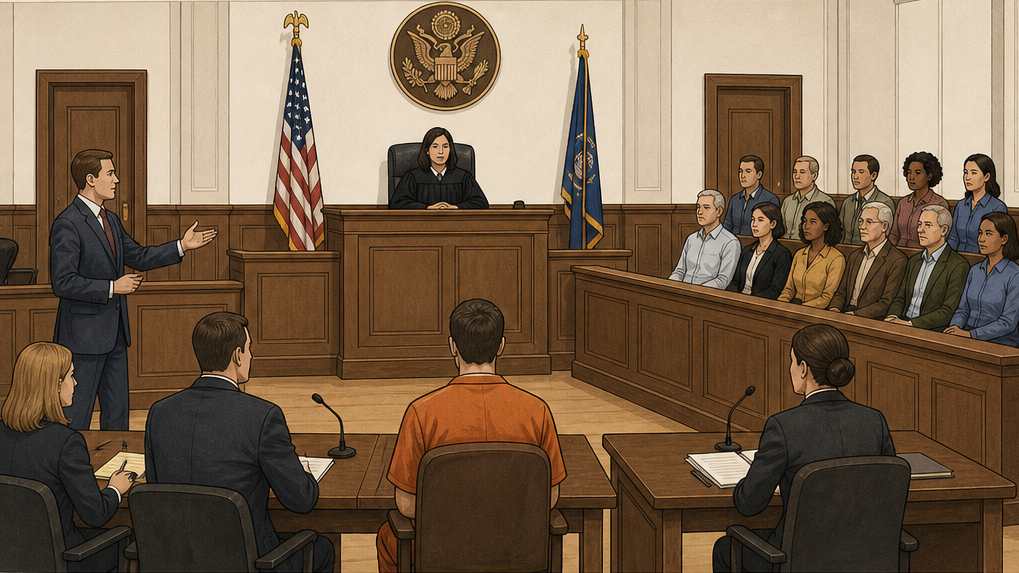
Theft of the Jury

The Foundation of the Rule of Law
“Law is largely a tool to regulate interpersonal relationships and spiritual practice is about organizing personal life. No law or legal system can be conceived like a mechanical system devoid of spirituality. Law, divorced from spirituality, does not address the fundamental issues of society rather it keeps on compiling cosmetic solutions, which appear to be superficial medicines against the structural maladies. Unfortunately, the origin of conflict too is often ignored by law and legal system.”
The purpose of law is justice which should have a higher spiritual quotient.
“Spirituality has the potentiality to identify and remove the root cause of conflicts.”
“When judges and lawyers infuse spiritual values in enforcing laws, we could aim to achieve a better society.”(Taken from, Exploring the Bonds Brochure BY: CAMPUS LAW CENTRE IN COLLABORATION WITH ETHIC CRAFT CLUB UNIVERSITY OF DELHI August 2021)
The Foundation of the Rule of Law
In Marbury v. Madison: 5 US 137 (1803) it is stated that “The government of the United States has been emphatically termed a government of laws, and not of men. It will certainly cease to deserve this high appellation, if the laws furnish no remedy for the violation of a vested legal right.”
Marbury v. Madison, decided by the United States Supreme Court in 1803, is a landmark case that laid the foundation for the principle of judicial review in the American legal system. This case arose in the context of a fierce political struggle between the Federalists and the Democratic-Republicans during the early years of the United States. At the center of the dispute was William Marbury, a Federalist appointed as a justice of the peace in the District of Columbia by outgoing President John Adams. However, his commission was not delivered before Thomas Jefferson assumed the presidency, leaving Marbury’s appointment in legal limbo.
The key players in this historic case included Chief Justice John Marshall, who presided over the Supreme Court, and then-Secretary of State James Madison, who was responsible for withholding the commission. Marbury’s insistence on obtaining the commission led him to file a writ of mandamus, a court order compelling Madison to act in accordance with the law. This confrontation was not just about Marbury’s appointment but also highlighted the broader implications for the balance of power between the different branches of government.
One of the significant contributions of Marbury v. Madison is the establishment of judicial review, a crucial aspect of American jurisprudence that empowers the judiciary to invalidate laws and executive actions that are inconsistent with the Constitution. This case set a precedent that underscored the role of the Supreme Court as a co-equal branch of government, responsible for interpreting the law and ensuring that the Constitution remains the supreme law of the land.
Overall, Marbury v. Madison represents a pivotal moment in the development of the rule of law in the United States. It underscores not only the complexities and limitations inherent in the political landscape of the time but also the enduring framework within which American governance operates today.
The Importance of a Government of Laws
The principle of a ‘government of laws and not of men’ is foundational to the establishment of a democratic society where the rule of law prevails over the whims of individuals. This concept asserts that every citizen, including government officials, is subject to the law. Thus, it ensures that laws are applied consistently and fairly, promoting justice and protecting individual rights. The significance of this principle cannot be overstated, as it serves as a cornerstone for both the legitimacy of government and the protection of civil liberties.
In essence, a government bound by laws creates an environment where power is neither arbitrary nor unchecked. It holds that laws must be transparent, accessible, and applicable to all members of society. This is critical for maintaining social order and establishing trust between citizens and the state. When laws are upheld consistently, citizens are more likely to respect the social contract that governs their interactions and relationships within the community.
The landmark case of Marbury v. Madison (1803) exemplifies how the principle of a government of laws functions in practice. By establishing the precedent of judicial review, this case reinforced the judiciary’s role in interpreting the law and ensuring that government actions comply with the Constitution.
This judicial check is crucial for maintaining legal rights and remedies, allowing courts to invalidate actions by the executive or legislative branches that may infringe upon individual freedoms. As a result, Marbury v. Madison not only cemented the importance of law in governance but also emphasized the necessity for an independent judiciary to uphold and defend constitutional principles.
Key Legal Principles Established
The landmark Supreme Court case of Marbury v. Madison, decided in 1803, established several critical legal principles that continue to influence the American legal landscape. Primarily, it introduced the concept of judicial review, which allows the judiciary to invalidate laws and executive actions that are found to be in conflict with the Constitution. This principle serves as a cornerstone of the rule of law, ensuring that no one is above the law and that governmental powers remain in check.
Judicial review created a vital balance of power among the three branches of government: the legislative, the executive, and the judiciary. By asserting its authority to interpret the Constitution, the Supreme Court positioned itself as a key arbiter in disputes regarding governmental authority and individual rights. This function not only protects civic liberties but also fosters a legal environment where laws must adhere to constitutional standards.
Furthermore, Marbury v. Madison underscores the importance of procedural justice by illustrating that individuals have a right to seek remedies through the courts when their rights are infringed upon. William Marbury’s petition exemplifies the struggles individuals face when government actions appear to circumvent established legal protocols. As a result, this decision emphasizes the judiciary’s role in safeguarding personal rights against potential governmental overreach, thereby reinforcing the need for an independent judicial system.
The implications of these principles extend beyond the confines of the early 19th century, shaping contemporary interpretations of law and governance. The principles established in Marbury v. Madison continue to resonate today, as they serve as a reminder of the necessity for accountability within the government and the enduring importance of an independent judiciary in preserving democracy and individual liberties.
Impact and Legacy of the Ruling
The 1803 Supreme Court case, Marbury v. Madison, has profoundly influenced American jurisprudence and remains a cornerstone in the study of constitutional law. Its declaration of judicial review established the principle that courts have the authority to invalidate laws and executive actions that violate the Constitution. This pivotal ruling has significantly shaped the balance of power within the U.S. government, reinforcing the judiciary’s role as a guardian of the Constitution.
One of the enduring legacies of Marbury v. Madison is its impact on the relationship between the legislative and judicial branches. The decision empowered the courts, ensuring they can serve as a check on legislative and executive actions, thus preserving individual rights and liberties. This function of the judiciary has become even more crucial in contemporary legal contexts, where issues of civil rights, environmental regulations, and executive power often arise. The precedent set by Marbury has equipped judges to interpret the Constitution actively and assert their independence from other branches of government.
Moreover, Marbury v. Madison has been cited in numerous landmark cases, reinforcing its relevance in ongoing legal debates. The ruling has been referenced in discussions surrounding the scopes of governmental power, the extent of federal authority, and the protections afforded by the Constitution. As society evolves, the principles established in this case continue to guide judicial reasoning and decision-making, ensuring that the rule of law is upheld.
In contemporary America, the effects of Marbury v. Madison are observable in landmark decisions regarding health care, immigration, and civil rights, demonstrating its lasting influence. As debates over the limits of governmental power persist, the case remains a crucial point of reference. Its foundational role in establishing the judiciary’s authority ensures that the impact of Marbury v. Madison will endure, affecting both law and governance for generations to come.
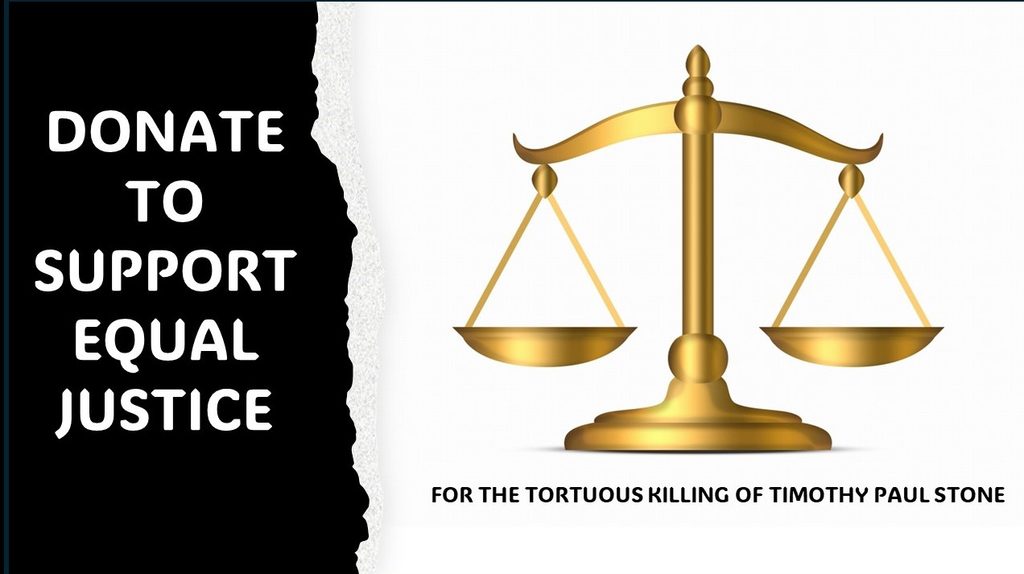
Help Restore the Children’s Civil and Human Rights. Click Here to Donate to the Stone’s Legal Fund.

Who Was Timothy and What Happened?

February 28, 2024, Timothy celebrated his 34th birthday, and on March 2, 2024, he suddenly passed away.
Met in high-school, Timothy had been with Sarea, for over 15 years. They married and had three-boys; the two youngest are autistic. Timothy worked for Cox Communications for almost 12-years. At the time of his death, he worked as a sales Engineer team leader and was highly regarded by his peers and superiors as having an advancing career with Cox. He loved family life, music, sports and cooking. During the age of two, Timothy developed juvenile (type 1) diabetes. Autopsy report says he died of the condition.
It was around 4pm, after being treated and recovering from a diabetic episode, and discharged from the hospital’s Intensive Care Unit when Timothy returned home and found his three sons missing. They were taken away by the sitter who refused to tell him at first where they were. He immediately called the El Mirage, AZ Police. When the officers arrived to take the report, they were told by the sitter that she took them to their mother, but her location was unknown. The mother had abandoned the family and had been living in Las Vegas for nearly a year and had obtained a job there. Timothy did not know his estranged wife was back.
From the time Timothy called 911 until his death, his basic rights as a citizen were trampled upon, as he was denied the fundamental protection he deserved as a custodial parent. Instead of finding support, he was met with indifference and obstruction, leaving him and his children exposed and defenseless. The relentless torment he endured, coupled with the blatant disregard for his and his children's safety, tragically led to his untimely demise.
Latest Posts
- Could Timothy’s Demise Be Linked to Parents’ Past?
 It IS possible that the deliberate nonaction is connected to Timothy’s parent’s public stance in opposition to corrupt governmental practices? For the past 25… Read more: Could Timothy’s Demise Be Linked to Parents’ Past?
 - The “Equal Justice” PollWe have spent 5,000 hours doing the work the police refused to do. We have uncovered a 'Counterfeit Order' enterprise where the Law is… Read more: The “Equal Justice” Poll
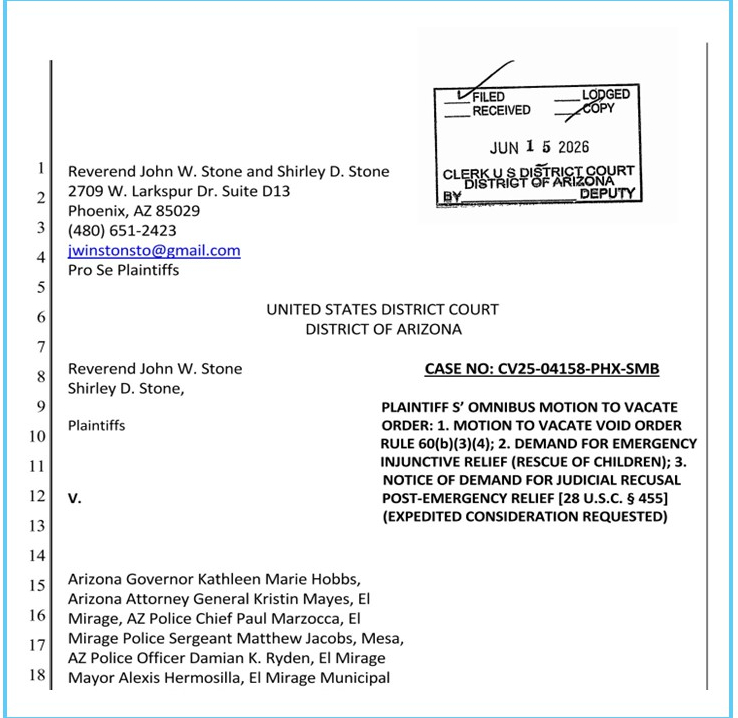
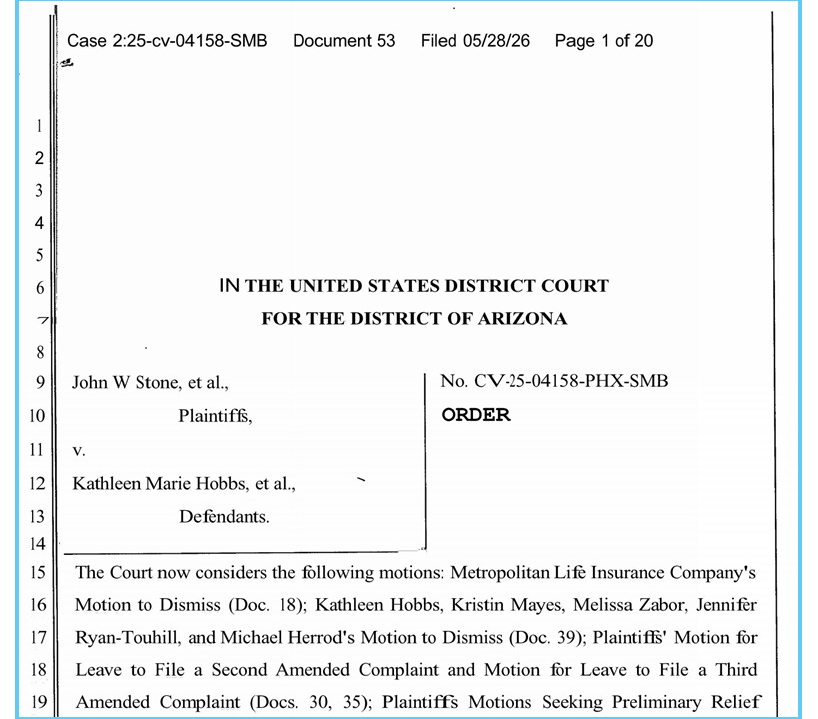
- Theft of the JuryIn response to Judge Brnovich’s May 28, 2026, order, we, the plaintiffs filed a "Motion to Vacate the Order" on the grounds that the… Read more: Theft of the Jury
- When Court Procedures Become a ShieldA Public Warning About Judicial Immunity, Civil Rights, and Access to Justice This article is written for a general audience and summarizes legal arguments… Read more: When Court Procedures Become a Shield
- Plaintiffs Filed Omnibus Reply to Defendants’ ResponsesIn CASE NO: CV25-04158-PHX-SMB: In the Arizona Federal District Court, Plaintiffs Filed Omnibus Reply to Defendants’ Responses to Vacate May 28, 2026, Order as… Read more: Plaintiffs Filed Omnibus Reply to Defendants’ Responses
- The Spiritual Meaning of ‘We the People’During the late 18th century, the political landscape was charged with debates about governance, individual rights, and the responsibilities of citizenship. The framers of… Read more: The Spiritual Meaning of ‘We the People’
- Understanding Children’s Civil Rights in the USIntroduction to Children’s Civil Rights The concept of children’s civil rights is essential for understanding the inherent rights that every child possesses, akin to… Read more: Understanding Children’s Civil Rights in the US
- Judge Ordered Kids to Stay with KidnappersAfter the Kidnapping and Death of Their Father, Federal Judge Susan M. Brnovich Followed the Defendant Officials in Keeping the Children with Their Captors,… Read more: Judge Ordered Kids to Stay with Kidnappers
- The Equality of Men and LawTaken from the Declaration of Independence para. 2 (U.S. 1776); it was declared, “…all men are created equal, that they are endowed by their… Read more: The Equality of Men and Law
- Motion to Vacate May 28, 2026, Void Order









VIDEO
Stone's Legal Fund