When the Truth Cannot Be Changed
When the Truth Cannot Be Changed
Click to Listen to Audio Reading
There are times when a story becomes larger than the people who lived it. It becomes a question of truth.Not the truth as someone wishes it had happened. Not the truth after it has been rearranged into a convenient explanation. Not the truth after facts have been omitted, softened, reclassified, or interpreted through a different lens.
But what actually happened?
Timothy’s story begins with something painfully simple: a father wanted his children. After returning home from intensive medical treatment, Timothy was separated from his sons. The children were taken from him, and for 54 days he was kept apart from them while he continued trying to have the situation addressed.
For a father, separation from his children is not merely a legal circumstance. It is an emotional event. It is a psychological event. And when a person is already physically vulnerable, the consequences of prolonged stress cannot simply be dismissed as irrelevant to the human being experiencing it.
Timothy asked for help.
The family maintains that help that should have been provided was not provided. Requests that should have triggered protection or intervention were not treated according to what the family believes the governing law required. And eventually, the circumstances were legally characterized in a way the family contends did not reflect what actually happened.
That distinction matters. Because law is supposed to be applied to facts. The facts do not become different because someone describes them differently. A door that was opened does not become closed because someone later says it was never opened. A child who was taken does not become a child who was never taken because the event is described differently.
A request for help does not cease to have been made because the request is later overlooked. And a consequence does not disappear simply because the events leading to it are given another interpretation. This is where Timothy’s story becomes more than a legal dispute. It becomes a question of human responsibility.
The Spiritual Question
Spiritually, one of the deepest lessons is that truth does not require our agreement in order to remain true. We can deny truth. We can resist it. We can reinterpret it. We can avoid it. We can build an argument around it. But none of those things change the truth itself. Truth simply remains.
That principle appears throughout spiritual teachings: reality is not created by our denial of it. Our perception may change, our interpretation may change, and our willingness to acknowledge something may change—but what actually occurred remains what occurred. This creates a profound spiritual responsibility. Every person involved in an event has a choice.
We can look honestly at what happened, or we can protect the version of reality that is most comfortable for us. We can ask, what is true? Or we can ask, how can I explain this so that I do not have to confront what is true? Those are very different questions. And perhaps that is one of the greatest lessons in Timothy’s story. The avoidance of truth does not eliminate the truth. It only postpones the moment when truth must be faced.
The Psychology of What Happened
There is also a psychological dimension.
When people are placed in positions of authority, they are given something more than power. They are given responsibility.Power can create distance from consequences. The person making a decision may not personally experience the fear, grief, helplessness, or physical consequences experienced by the person affected by that decision. This creates a dangerous psychological possibility:A human being can begin to see a situation as a case rather than a life. A file rather than a father. An incident rather than a family. A procedure rather than a human consequence. Once this happens, it becomes easier to defend a decision than to reconsider it.
Psychology teaches us that people naturally seek consistency with decisions they have already made. Once a conclusion has been reached, contradictory information can become uncomfortable. Instead of changing the conclusion, there can be a tendency to reinterpret the information. That is precisely why truth requires something more than intelligence. It requires humility. The willingness to say: “Perhaps I need to look again.” “Perhaps something was missed.” “Perhaps the facts do not fit the conclusion I reached.” And most importantly: “What actually happened?”
The Law and the Truth
Law exists, in part, because society recognizes that power must have boundaries. The law establishes duties, rights, procedures, and consequences so that individual lives are not left entirely to the discretion of whoever happens to possess authority at a particular moment. Where a law clearly applies to established facts, the question should not be what story is most convenient. The question should be: What happened, what law applies to those facts, and what consequence does that law provide?
If the facts are changed, the legal conclusion may change. But changing the description of the facts is not the same thing as changing the facts themselves. That is where the family’s concern reaches beyond Timothy. It becomes a question about whether justice is possible when the event being judged is no longer the event that actually occurred. Because law can be misunderstood. It can be misapplied. It can be narrowly interpreted. It can be avoided through procedural arguments. And human beings can make mistakes. But none of those things alter reality. Truth remains truth.
The Cost of Looking Away
Timothy’s final departure gives this story its greatest weight.
The family believes that the prolonged separation from his children, the failure to obtain the help he sought, and the circumstances surrounding those 54 days aggravated an already serious physical condition and contributed to the deterioration that preceded his death. That connection must ultimately be evaluated through the evidence and the appropriate legal process. But there is a human truth that requires no courtroom to understand: A father was separated from his children. He wanted them back. He asked for help. He remained separated from them for 54 days. And then he was gone. His children were left without their father. The question therefore cannot simply be, Who was right?
There is a deeper question: What happens when human beings fail to recognize the consequences of what they are doing while they still have the opportunity to change course?
The Lesson of Conscience
Perhaps the spiritual lesson is ultimately about conscience. Conscience is that inner place where we know that something matters even before someone else tells us that it matters. It asks us to look beyond technicalities and ask: Was this right? Was this truthful?Did this protect the vulnerable? Did I do everything within my power to prevent harm? If I had known the ultimate consequence, would I have acted differently?
And perhaps the most difficult question of all: If I were wrong, would I be willing to admit it? That question belongs to everyone. It belongs to parents. It belongs to grandparents. It belongs to police officers. It belongs to attorneys. It belongs to judges. It belongs to government officials. And it belongs to ordinary people who witness something happening and decide whether to look away. Because authority does not remove moral responsibility. In fact, greater authority creates greater responsibility.
What Remains
Timothy cannot be brought back. The 54 days cannot be returned. The children cannot be given back those days with their father. What happened cannot be undone. But something can still be done with the truth. It can be examined. It can be documented. It can be brought into the light. It can be compared with the law that was supposed to govern it. And it can become a lesson for those who come afterward. Perhaps that is where Timothy’s story ultimately belongs—not only in a courtroom, but in the larger human conversation about truth and responsibility. Because justice is not merely about winning an argument.
Justice begins with the willingness to see reality as it is. And when reality is painful, that may be the hardest form of courage there is. People can disagree about what something means. They can disagree about what should have happened. They can even disagree about what the law requires. But there is a foundation beneath all of those disagreements:
What actually happened?
Truth is truth.
That question cannot be escaped forever. For truth does not become false because it is denied. It does not become uncertain because it is inconvenient. It does not become something else because it is placed inside a different narrative. And truth never changes. The only thing that changes is whether we are willing to see it.
Theft of the Jury

Judge Ordered Kids to Stay with Kidnappers
After the Kidnapping and Death of Their Father, Federal Judge Susan M. Brnovich Followed the Defendant Officials in Keeping the Children with Their Captors, Preventing Their Day in Court.
The 'Wrongful Death' and 'Civil Rights' lawsuit filed in Federal Court tells of a troubling chain of events involving a continuing kidnapping, protection orders, law enforcement inaction, and the death of Arizona father, Timothy Paul Stone.
The civil lawsuit, brought by Timothy's parents, Reverend John Stone and Shirley Stone, raises serious questions about the protection of vulnerable adult and children, the enforcement of court orders, and the responsibilities of public officials when families report imminent danger. The lawsuit seeks accountability for what the plaintiffs describe as a series of failures that culminated in the death of Timothy Paul Stone on March 2, 2024, after 54-days of attempting to retrieve his children.
A Family in Crisis
According to the court filings, Timothy was a dedicated father of three boys, two of whom had been diagnosed with autism. He was employed by Cox Communications for 12-years and had lived with Type 1 diabetes since childhood. The lawsuit provided that Timothy became the children's primary custodial parent after his estranged wife, Sarea McCree, abandoned the family and relocated to Nevada in March 2023. Court proceedings that followed reportedly resulted in protection orders intended to protect both Timothy and the children from alleged threats of kidnapping and harm. The Stones had presented proof that the legal system had already recognized concerns regarding the children's safety months before the events that would unfold on January 9, 2024.
January 9, 2024: The Day Everything Changed
The lawsuit stated that on January 9, 2024, Timothy was hospitalized during a serious diabetic emergency. While he was awaiting his release, Brittany Houston, the babysitter and household resident, took his automobile and removed his three children from their home without authorization. The children were transported and delivered to Sarea and her sister, Heiress Dupree, despite existing court orders that prohibited contact between them. When Stone returned home from the hospital and discovered his children were gone, he immediately contacted law enforcement. What followed forms the core of the Stones' claims.
Claims of Inaction
The lawsuit claims that local law enforcement officers were informed that the children had been taken without permission and were made aware of the existence of valid protection orders. According to the complaint, officers acknowledged the court orders and recognized the potential danger posed to the children, yet no meaningful effort was made to recover them. The Stones also professed that Timothy and his family repeatedly contacted police departments, elected officials, judges, and state agencies seeking assistance; more than 200 notices, complaints, reports, emails, and communications were said sent to various government officials during the days of non-action. Among those contacted, according to the lawsuit, were representatives of the Governor's Office, the Attorney General's Office, local police leadership, and members of the judiciary. The Stones assert that despite these repeated warnings, no agency took effective action to secure the return of the children.
The Human Cost
As the weeks passed, Timothy reportedly became increasingly desperate to locate and recover his children. The lawsuit describes a father caught between a medical condition that required careful management and an escalating emotional crisis involving the loss of contact with his children. Family members witnessed the ongoing separation, combined with the stress of navigating the legal system and seeking help from authorities, severely affected his health. On March 2, 2024—54 days after the children were taken—Timothy was found dead in his apartment. The lawsuit contends that the emotional trauma associated with the kidnapping and the subsequent failures of authorities directly contributed to his death.
What Happened After His Death?
The controversy did not end with Timothy's passing. According to the complaint, hearings were held after his death concerning emergency motions that had been filed in an effort to rescue the children and enforce existing court orders. The lawsuit stated that the court declined to address key issues surrounding the children's welfare and that opportunities to present evidence regarding their safety were denied. The lawsuit further claimed that the children remained separated from their paternal family and that concerns regarding their well-being continue today.
Protection Orders Issued, Ignored to Not Enforce
Beyond the specific facts of one family's tragedy, the Stone's case raises broader questions about how government agencies respond when parents report that children are in danger.
In Timothy's last motion filed with the municipal court and entered as an exhibit with their 'Emergency Motions", he told the court, "The defendant (Sarea) has displayed to this Court that She is subject to disregard any Order this Court issues. The defendant has also shown that she will abandon her Children whenever she feels like it. She believes there should be NO consequences for emotionally abusing her children. The defendant knows that 2 of her children are autistic. The defendant's acts against her children are “Cold-Blooded”. The plaintiff has evidence where the defendant made sure the children were watching her attempt suicide on 2-separate occasions, the a few months later abandoning the family when she fled to Las Vegas, NV."
The above was evidenced in the court filings indicating why the protection order were against the mother and why the grandparents are concerned. Municipal Judge Michael Parascandola, a defendant, dismissed the protection order he gave the children, taking away their protection, violating their constitutional rights because their dad had died.
The lawsuit challenges whether existing child-protection systems function effectively when multiple agencies possess information about the harm or possible harm but fail to coordinate action. It also raises questions regarding accountability when court orders exist but are not enforced.
The Insurance Dispute
The case also involves a dispute over life insurance benefits. Following Timothy's death, the plaintiffs contend that they submitted extensive documentation to Metropolitan Life Insurance Company (MetLife) challenging the eligibility of the policy's primary beneficiary. The lawsuit alleges that despite receiving numerous documents and communications concerning the circumstances surrounding Timothy's death, the insurer ultimately declined to disqualify the beneficiary, Sarea. As a result, the complaint includes claims involving insurance benefits, fiduciary duties, and related financial damages.
The Legal Claims
The Stones filed the wrongful death claim, under Arizona Revised Statute § 12-612, which states that minor children are "parties in interest" (statutory beneficiaries) and that the statute explicitly requires the lawsuit to be filed on their behalf. ARS 12-612 designates surviving spouses, children, and parents as the primary statutory beneficiaries. But Judge Brnovich ruled that the children were "not parties in interest" and questioned the grandparents' "standing".
The federal lawsuit contains a wide range of allegations, including:
- Wrongful Death
- Civil rights violations
- Custodial interference
- Kidnapping and false imprisonment
- Conspiracy to violate civil rights
- Negligence
- Emotional distress
- Elder abuse
- Child endangerment
- Vulnerable Adult and Child abuse
- Insurance-related claims
- Breach of fiduciary duty
The defendants named in the lawsuit include private individuals, law enforcement personnel, public officials, judges, and corporate entities. At this stage, the claims asserted by the plaintiffs had not been addressed in court by a jury, and as such, the Stones and their grandchildren were denied due process of law, and the "Order is Void" for "Fraud on Court".
Why This Case Matters
For the Stone family, the case is about far more than legal claims or financial damages. They argue that it concerns the constitutional rights of children, the government’s duty to protect vulnerable individuals, and the responsibility of institutions to follow the law and act when lives are at stake. In their view, the litigation should have been allowed to move forward, and the questions at issue should have been examined by a jury rather than decided by what they believe was a partial judge acting on camaraderie rather than statutory law.
The US Constitution and Case Law Provides the Following:
Article VI Clause 2 declares: This Constitution, and the laws of the United States which shall be made in pursuance thereof; [...] under the authority of the United States, shall be the supreme law of the land...
"The concept of the written constitution is that it defines the authority of government and its limits, that government is the creature of the constitution and cannot do what it does not authorize and must not do what it forbids."
In Marbury v. Madison: 5 US 137 (1803) it is stated that "The government of the United States has been emphatically termed a government of laws, and not of men. It will certainly cease to deserve this high appellation, if the laws furnish no remedy for the violation of a vested legal right.
Chief Justice Taney similarly stated that, "so long as the Constitution remains in its present form, it speaks “not only in the same words, but with the same meaning and intent” as when it was framed, ratified, and adopted by the people of the United States. "Scott v. Sandford, 60 U.S. 393, 426 (1857).
[...] judges in every state shall be bound thereby, anything in the Constitution or laws of any State to the contrary notwithstanding acting upon seditious legislative acts joins the conspiracy of subversion; “[...] if then the courts are to regard the constitution and the constitution is superior to any ordinary act of the legislature; the constitution, and not such ordinary act, must govern the case to which they both apply.
Supreme Court Justice Field stated, "There is no such thing as a power of inherent sovereignty in the government of the United States... In this country, sovereignty resides in the people, [...]" Juliard v. Greeman, 110 U.S. 421 (1884)
"The recognition of children's right to be heard and to participate in decision-making processes is an essential aspect of their civil rights in the United States. This principle is rooted in various international conventions, most notably the United Nations Convention on the Rights of the Child (UNCRC), which emphasizes that children should have the opportunity to express their views freely on all matters that affect them."
Children Violated, Statutory Rights Denied
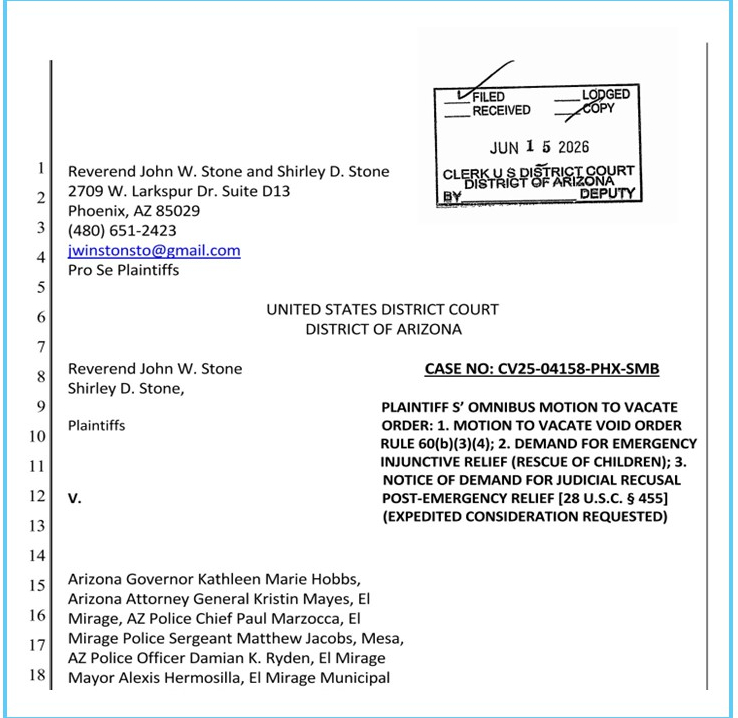
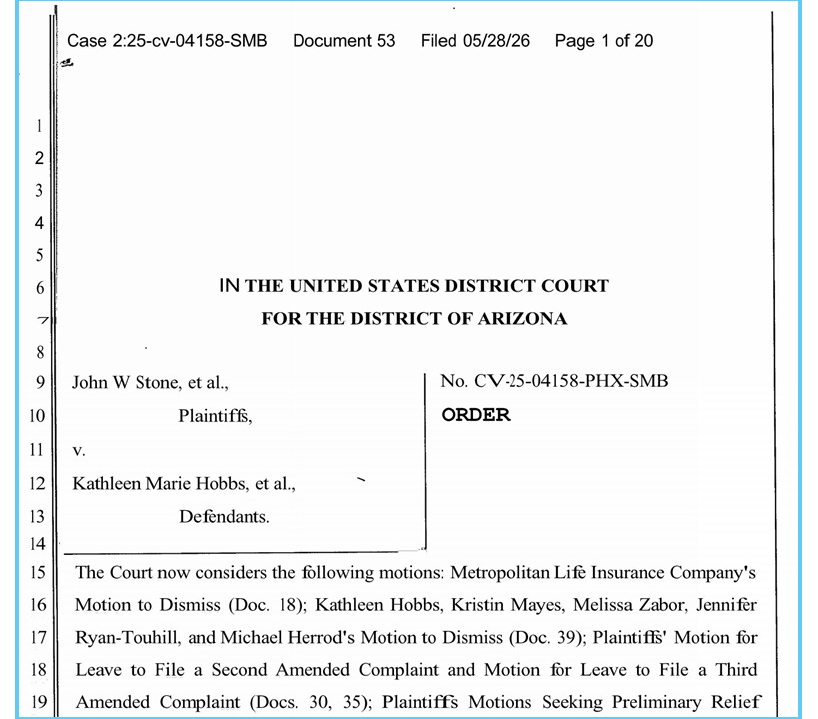
The Stones contend that within days of filing the complaint they and their three grandchildren were retaliated against by Federal District Court Judge Susan M. Brnovich. Judge Brnovich set-forth in her May 28, 2026, order that she did not believe that the three minor children were kidnapped and were in much DANGER.
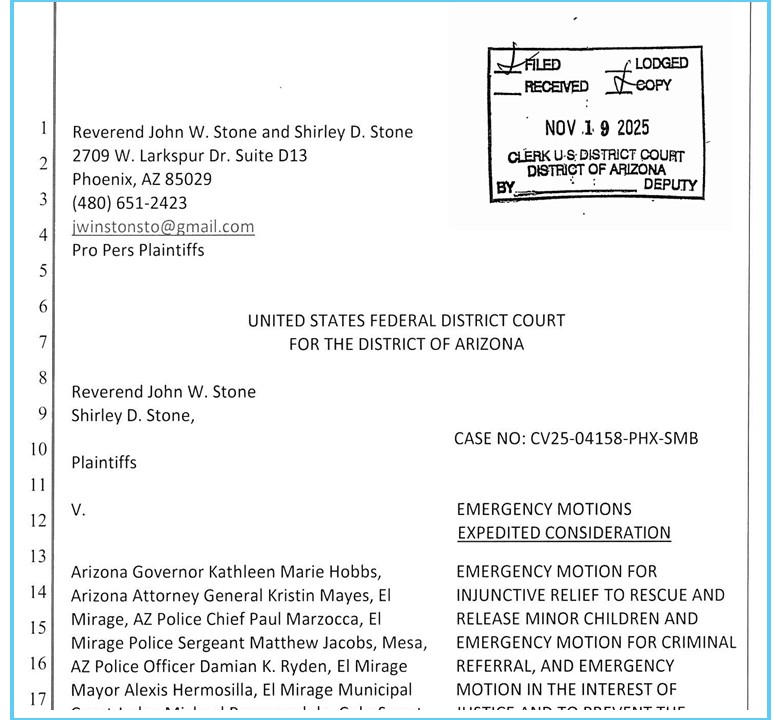
On November 19, 2025, the Stones filed an EMERGENCY MOTION, with correlating documents, that justified the "rescue' of the children. Judge Brnovich had before her all the evidence that she has now. Judge Brnovich knew that all three kidnappers had valid protections orders against them and that all three children and their father were the petitioning plaintiffs on those protection orders. The kidnappers were not to come near the children or the father because they were a danger to them. The kidnappers had crossed from Nevada to Arizona to severely injure the kid's father and kidnap the children. Court documents provided that the kidnappers had threatened to "MESS UP" the father and kidnap the kids on April 5, 2023, during a telephonic conversation.
Judge Brnovich left the children with the "dangerous" kidnappers knowing that one of the kidnappers "self-diagnosed as having PTSD” and is the children's estranged mother who had abandoned them for almost a year. Sarea has a long history and pattern of psychotic episodes as demonstrated in court documents that she literally gathered the children together and attempted suicide on several occasions. One of the other kidnappers, Brittany Houston, was out of jail on bond for crimes committed against her own minor children and was believed caused Timothy's diabetic condition, that led to his hospital visit on January 9, 2024, the day of the kidnapping.
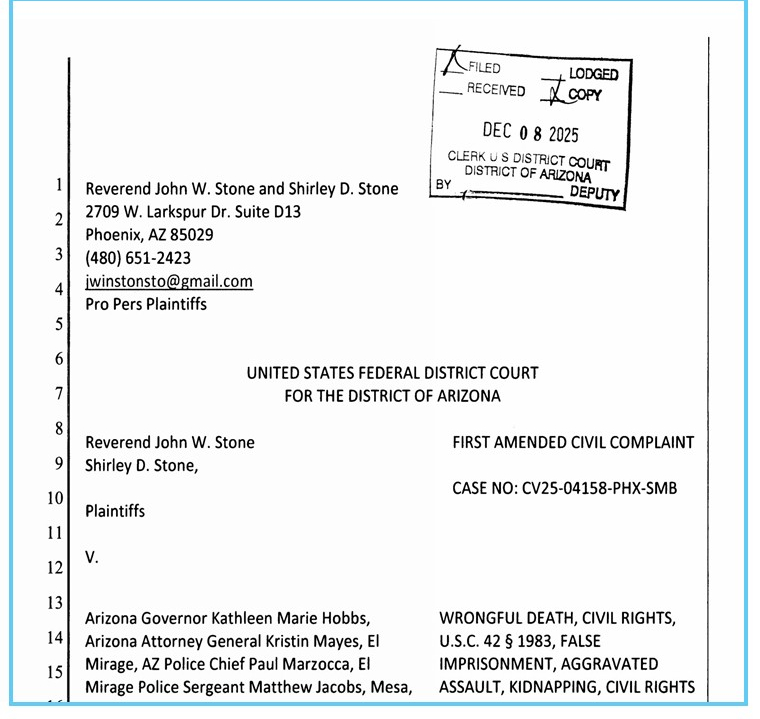
The Stones asserted in their Motion to Vacate May 28, 2026, Order, Judge Brnovich “elected” to grossly violate her oath and numerous laws by getting rid of by first sanitizing and twisting the facts in the First Amendment Complaint (FAC) and the Emergency Motions into a narrative that would AID the unlawful escape from justice for Governor Hobbs, Attorney General Mayes, and the other defendants; and keep the children as kidnapped victims, denying their beneficiary and constitutional rights.
Read the Stones "Omnibus Motion to Vacate the Order", "First Amendment Complaint", and "Emergency Motions". Get the Judge's May 28, 2026, order for federal Case No: CV25-04158-PHX-SMB from Pacer.com.
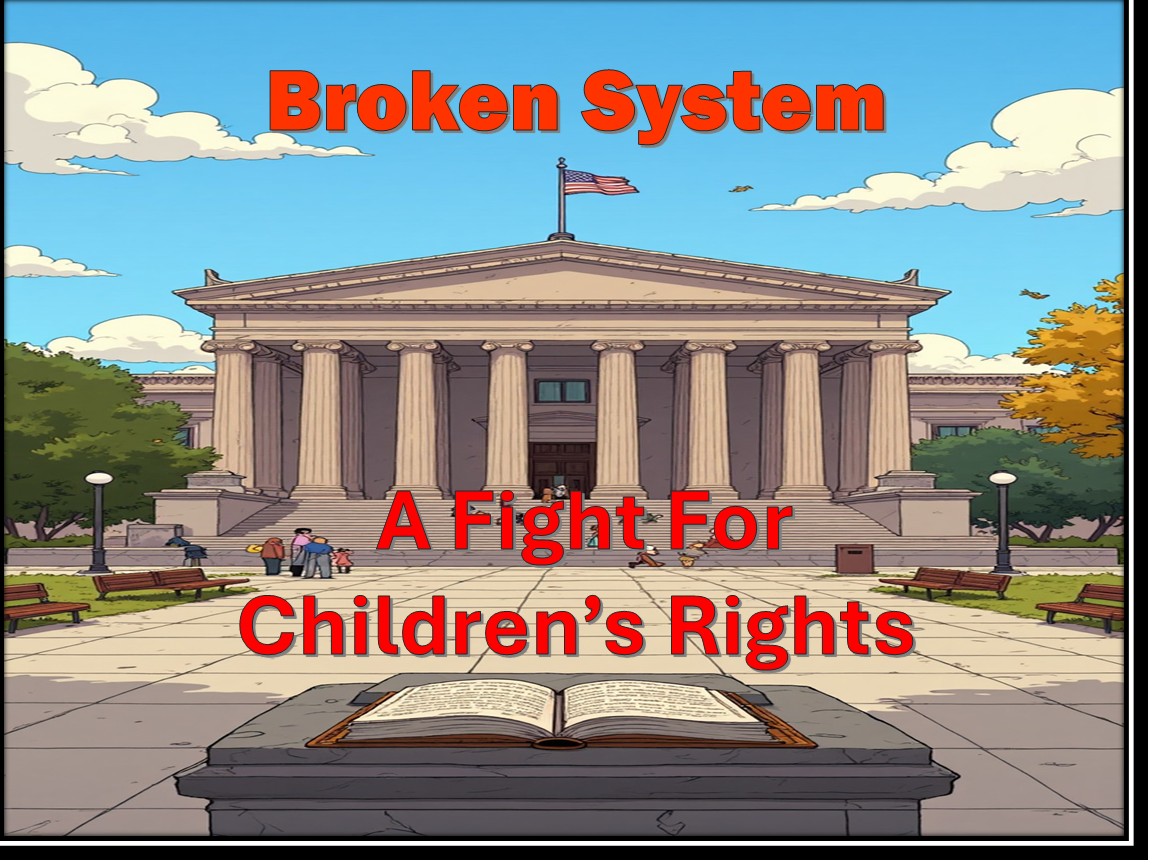
The Stones vow to exhaust every legal remedy available to them to restore the rights of the children. The Stones are asking for public support to fight for the children's constitutional civil and human rights that give rise to violations of all children, as a pattern and practice of Arizona's legal system that ignores the law at a whim. See video; Broken System-Arizona Cover-up
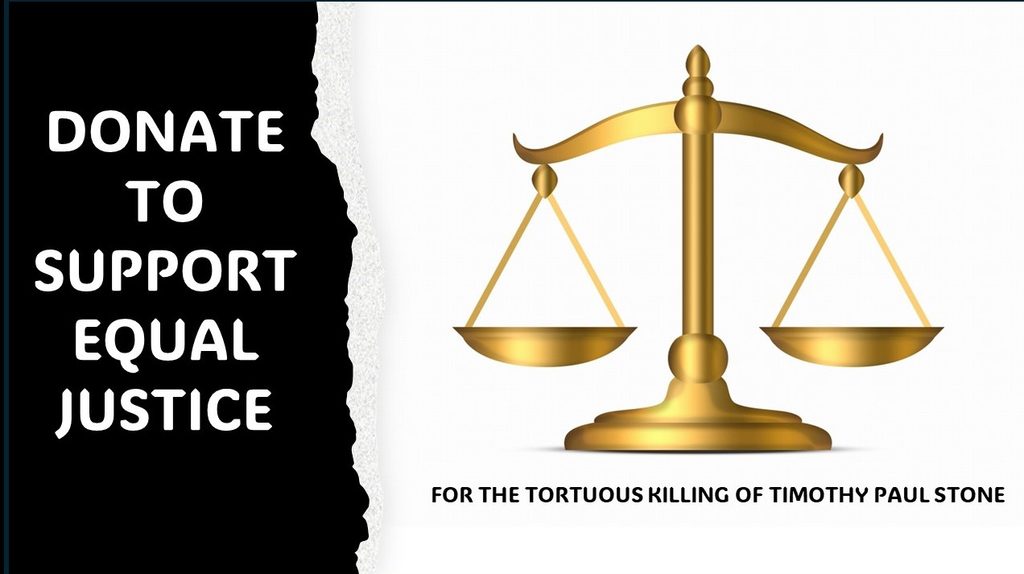
Help Restore the Children's Civil and Human Rights. Click Here to Donate to the Stone's Legal Fund.

Motion to Vacate May 28, 2026, Void Order
First Amendment Complaint (FAC)
Emergency Motions to Rescue Children

The Human Cost of Family Abduction

Understanding the Legal Relationship

The Human Impact Shown in Stone’s Emergency Filing

Latest Posts
- When the Truth Cannot Be Changed
 When the Truth Cannot Be Changed Click to Listen to Audio Reading There are times when a story becomes larger than the people who… Read more: When the Truth Cannot Be Changed
 - Could Police Nonaction Be Linked to Parents’ Past?It IS possible that the deliberate police nonaction is connected to Timothy’s parent’s legal past? For the past 25 years, Timothy’s parents, Reverend John… Read more: Could Police Nonaction Be Linked to Parents’ Past?
- The “Equal Justice” PollWe have spent 5,000 hours doing the work the police refused to do. We have uncovered a 'Counterfeit Order' enterprise where the Law is… Read more: The “Equal Justice” Poll
- Theft of the JuryIn response to Judge Brnovich’s May 28, 2026, order, we, the plaintiffs filed a "Motion to Vacate the Order" on the grounds that the… Read more: Theft of the Jury
- When Court Procedures Become a ShieldA Public Warning About Judicial Immunity, Civil Rights, and Access to Justice This article is written for a general audience and summarizes legal arguments… Read more: When Court Procedures Become a Shield
- Plaintiffs Filed Omnibus Reply to Defendants’ ResponsesIn CASE NO: CV25-04158-PHX-SMB: In the Arizona Federal District Court, Plaintiffs Filed Omnibus Reply to Defendants’ Responses to Vacate May 28, 2026, Order as… Read more: Plaintiffs Filed Omnibus Reply to Defendants’ Responses
- The Spiritual Meaning of ‘We the People’During the late 18th century, the political landscape was charged with debates about governance, individual rights, and the responsibilities of citizenship. The framers of… Read more: The Spiritual Meaning of ‘We the People’
- Understanding Children’s Civil Rights in the USIntroduction to Children’s Civil Rights The concept of children’s civil rights is essential for understanding the inherent rights that every child possesses, akin to… Read more: Understanding Children’s Civil Rights in the US
- Judge Ordered Kids to Stay with KidnappersAfter the Kidnapping and Death of Their Father, Federal Judge Susan M. Brnovich Followed the Defendant Officials in Keeping the Children with Their Captors,… Read more: Judge Ordered Kids to Stay with Kidnappers
- The Equality of Men and LawTaken from the Declaration of Independence para. 2 (U.S. 1776); it was declared, “…all men are created equal, that they are endowed by their… Read more: The Equality of Men and Law







VIDEO
Stone's Legal Fund